How a plant builds sugar from carbon dioxide and water with light, where its mass and the oxygen it gives off come from, and what sets the rate.
Step 1 of 5 · From thin air
Step 1 of 5
From thin air
All the energy in your food, in bread, meat and chocolate, once came from the Sun, by way of a plant. Plants, algae and a few bacteria are the only living things that can build sugar from simple substances, and they do it by photosynthesis:
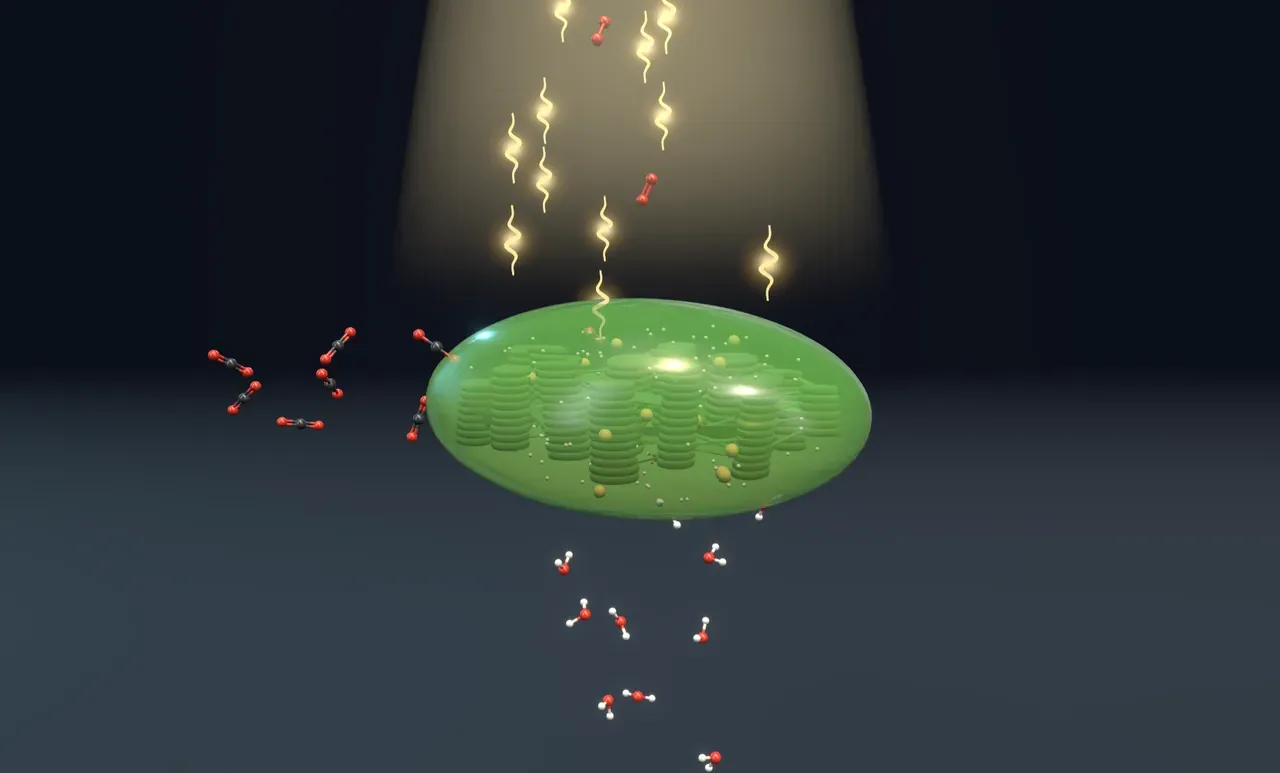
Carbon dioxide from the air and water from the roots become, with the energy of light, glucose and oxygen. The Scene shows a chloroplast: light packets fall on it from above, carbon dioxide molecules arrive from the left and water from below, sugar piles up inside it, and oxygen bubbles rise out.
Step 2 of 5
Light is energy
Light does not turn into matter. It supplies the energy that makes it possible to build a sugar molecule, which holds far more energy than the carbon dioxide and water it was built from. That energy stays stored in the sugar, until some cell breaks it down by respiration.
Step 3 of 5
Inside the chloroplast
Cut open has opened the chloroplast. Inside are stacks of membrane discs, grana, holding chlorophyll, the pigment that absorbs red and blue light and reflects green. Photosynthesis has two stages: in the discs, light splits water and charges up energy carriers; in the fluid round them, the stroma, that energy is used to join carbon dioxide into sugar.
Step 4 of 5
The scarcer input
Light and Carbon dioxide each arrive at their own rate. Sugar is built fast only when there is enough of both.
Step 5 of 5
The equation
The photosynthesis equation balances: there are as many of each kind of atom on both sides. Atoms are neither made nor lost; they are only rearranged.
Loading the interactive version…
Loading the interactive version…
Each step sets up the Scene for you, and a control marked “fixed” stays put for that step.
Practice · Choose
An oak grown from an acorn weighs tonnes after fifty years. Where did most of its dry mass come from?
Practice · Choose
An oak grown from an acorn weighs tonnes after fifty years. Where did most of its dry mass come from?
Practice · Predict, then look
The chloroplast is working in light at 70% of full sun, with plenty of carbon dioxide. Night falls: the light drops to zero. What will happen to the sugar making?
Practice · Predict, then look
The chloroplast is working in light at 70% of full sun, with plenty of carbon dioxide. Night falls: the light drops to zero. What will happen to the sugar making?
Practice · Choose
Which molecule does the oxygen a plant gives off in photosynthesis come from?
Practice · Choose
Which molecule does the oxygen a plant gives off in photosynthesis come from?
Practice · Calculate
Light is at 70% of full sun, and Carbon dioxide at 60% of plenty. At a comfortable temperature, at what percentage of the top rate is photosynthesis running?
Practice · Calculate
Light is at 70% of full sun, and Carbon dioxide at 60% of plenty. At a comfortable temperature, at what percentage of the top rate is photosynthesis running?
Practice · Calculate
A glucose molecule, , holds six carbon atoms. How many carbon dioxide molecules does the plant need to build one glucose molecule?
Practice · Calculate
A glucose molecule, , holds six carbon atoms. How many carbon dioxide molecules does the plant need to build one glucose molecule?
Lesson complete. Every practice question here is done.