The four groups of the molecules of life, how much energy each gram of carbohydrate, fat and protein holds, and how to work out the protein in a day's food.
Step 1 of 5 · Four groups
Step 1 of 5
Four groups
A living cell is mostly water: about seventy per cent. Nearly all the rest belongs to four groups of large molecules, all built round a skeleton of carbon:
- Carbohydrates: sugars, and long chains of them like starch. Ready fuel, and building material too (cellulose in plant cell walls).
- Fats (lipids): long-term energy stores, and what cell membranes are made of.
- Proteins: the cell’s enzymes, channels, muscles and skeleton. Most of the work in a cell.
- Nucleic acids: DNA and RNA, which carry the instructions.
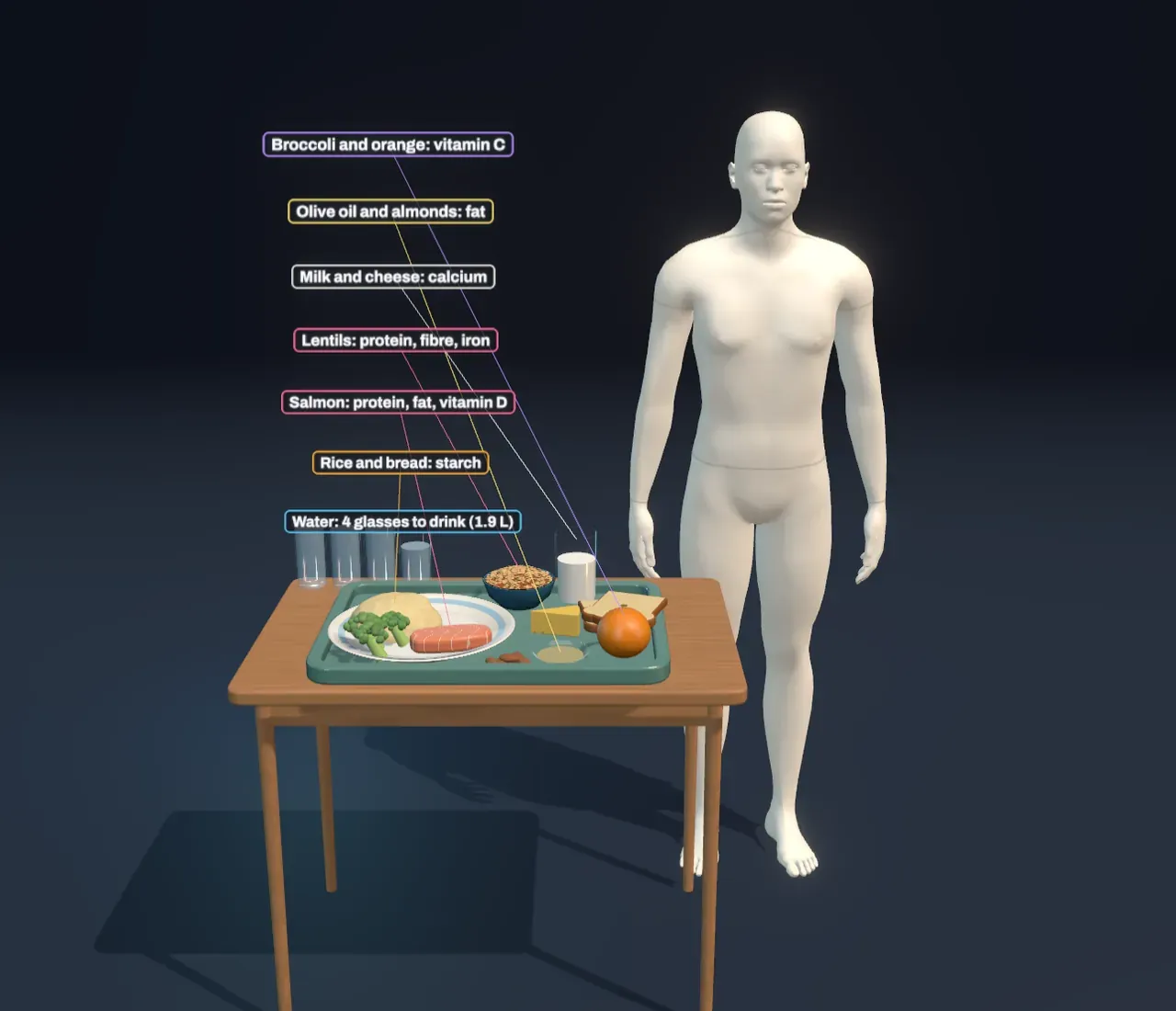
The tray in the Scene holds an ordinary day’s food. The first three groups we eat in large amounts; the fourth in small amounts, inside the cells of everything we eat.
Step 2 of 5
Protein on the tray
The energy in food is measured in kilocalories, kcal. In a varied day about half the energy comes from carbohydrates, a third from fat and a sixth from protein. To go from kilocalories to grams you need the energy in each gram:
| Energy per gram | |
|---|---|
| Carbohydrates | 4 kcal |
| Proteins | 4 kcal |
| Fats | 9 kcal |
Step 3 of 5
More protein
An adult needs about 0.8 g of protein per kilogram of body mass a day, to build and repair cells. Athletes build muscle, so they need more. Exercise is fixed now, and Food eaten in a day is free.
Step 4 of 5
Energy per gram
Follow the food is at Where it goes: the body beside the tray shows where the day’s energy goes, which organs burn it, and what is stored.
Step 5 of 5
A surplus
When you eat more than you spend, the body stores the surplus, mostly as fat under the skin. The day’s spending is made up of rest (the brain, liver, heart and muscles at rest), ordinary moving about, digestion itself, and exercise.
Loading the interactive version…
Loading the interactive version…
Each step sets up the Scene for you, and a control marked “fixed” stays put for that step.
Practice · Choose
Which group of the molecules of life does DNA, which holds the instructions for building the cell, belong to?
Practice · Choose
Which group of the molecules of life does DNA, which holds the instructions for building the cell, belong to?
Practice · Calculate
This day brings 2000 kcal, and a sixth of the energy comes from protein. A gram of protein holds 4 kcal. How many grams of protein are eaten in the day?
Practice · Calculate
This day brings 2000 kcal, and a sixth of the energy comes from protein. A gram of protein holds 4 kcal. How many grams of protein are eaten in the day?
Practice · Reach the target
An athlete wants 100 g of protein a day, from the same mix of food. Change Food eaten in a day until she gets it, then press Check.
Practice · Reach the target
An athlete wants 100 g of protein a day, from the same mix of food. Change Food eaten in a day until she gets it, then press Check.
Practice · Choose
Which holds the most energy per gram?
Practice · Choose
Which holds the most energy per gram?
Practice · Calculate
On a big day you eat 3200 kcal and spend 2550 kcal. If all the surplus is stored as fat, at 9 kcal per gram, how many grams of fat are stored?
Practice · Calculate
On a big day you eat 3200 kcal and spend 2550 kcal. If all the surplus is stored as fat, at 9 kcal per gram, how many grams of fat are stored?
Lesson complete. Every practice question here is done.