Fuel, building material and helpers
Everything you eat does one of three jobs. Some of it is fuel, burned to keep you warm, keep your heart beating and move your muscles. Some is building material, used to make and repair the body itself: muscle, bone, skin and blood. And a small part is helpers, substances needed in tiny amounts so that the body’s chemistry can run at all. On top of these the body needs water, which it loses all day, and fibre, which it cannot digest but which the gut needs anyway.
The substances that do these jobs are called nutrients. Three of them come in large amounts, tens or hundreds of grams a day, and are called macronutrients: carbohydrate, fat and protein. The others, vitamins and minerals, are micronutrients, needed in milligrams or even millionths of a gram. How food is taken apart into these pieces is told in Digestion. This Article picks up where it leaves off, with the question of what the body does with them.
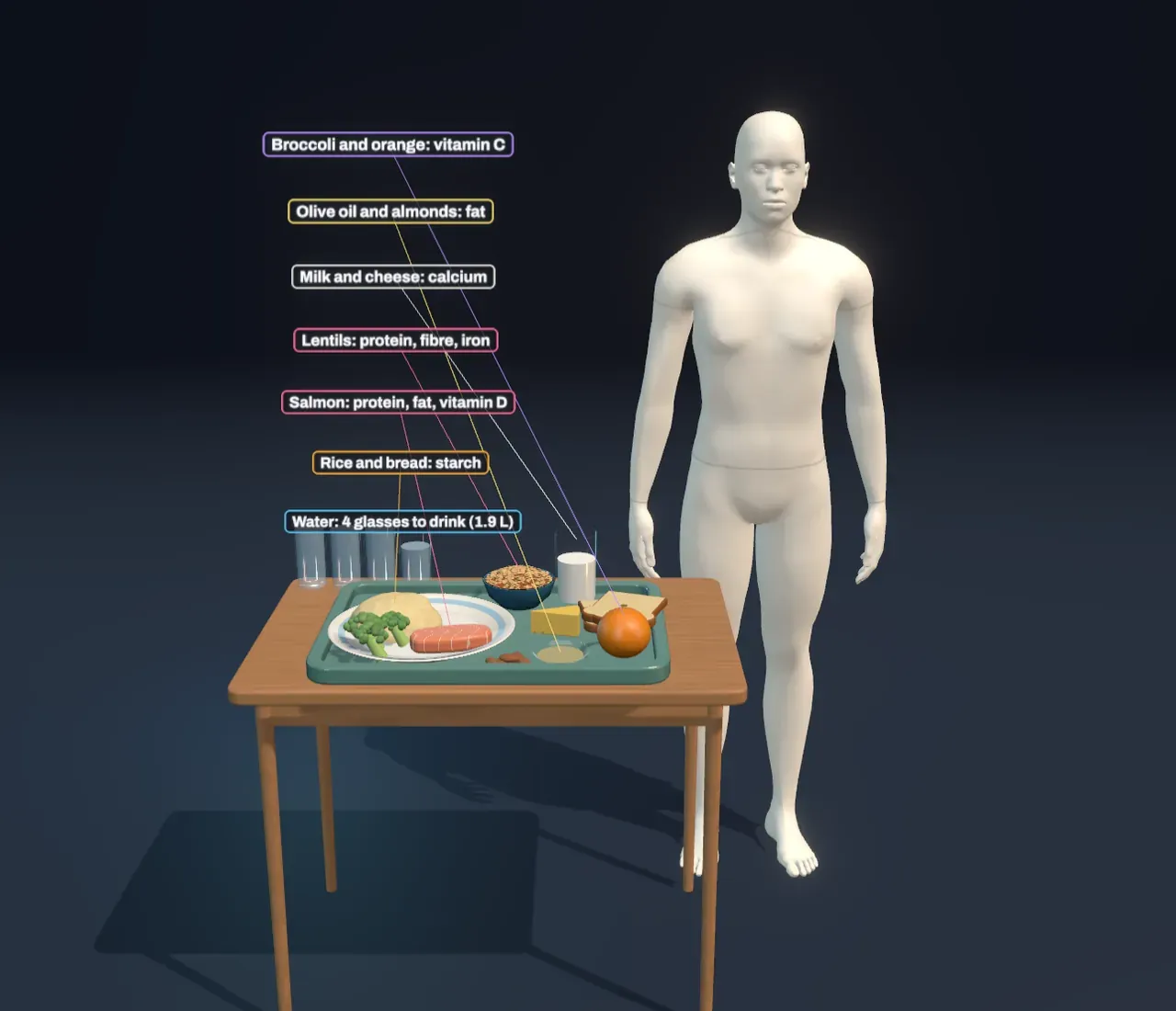
Try it: with Follow the food at Food, read the labels on the tray. Each food brings mostly one or two nutrients, which is why a day’s food is usually a mix.
Where a day’s energy goes
Food energy is measured in kilocalories (kcal, often written simply “calories” on food labels): one kilocalorie is the energy that warms a litre of water by one degree Celsius, or 4.184 kilojoules. Inside cells, fuel is burned slowly with oxygen in cellular respiration, and the energy is caught in small molecules of ATP that power every job a cell does.
An adult of 70 kg lying still all day still spends about 1700 kcal, the resting metabolism. The brain, only about one fiftieth of the body’s mass, uses about a fifth of this; the liver about a fifth too; the muscles, heart and kidneys most of the rest. Ordinary moving about, standing, walking from room to room, adds a few hundred kilocalories. Digesting food and storing it costs about a tenth of the energy the food contains. On top of this comes exercise: a brisk walk or an easy bike ride burns about 6 kcal a minute above rest for this person, so an hour adds about 360 kcal.
Try it: in the chart, the lower bar is the energy spent. Drag Exercise from 0 to 240 minutes and only the dark blue part grows: four hours of brisk exercise adds 1440 kcal, while the resting body’s share does not change at all.
Two fuels: carbohydrate and fat
Carbohydrates are sugars and the chains made of them. Starch in rice, bread, pasta and potatoes is a long chain of glucose, the sugar that every cell can burn and the one the brain relies on, about 120 grams a day. A gram of carbohydrate gives about 4 kcal. The body keeps only a small store of it, as glycogen: about 100 grams in the liver, which tops up the blood between meals (as Hormones and the endocrine system shows), and about 400 grams in the muscles, for their own use. That is roughly 2000 kcal, about a day’s worth.
Fat is the dense fuel: about 9 kcal a gram, more than twice as much as carbohydrate, and stored without the water that glycogen carries with it. Even a lean adult carries ten kilograms or more of fat, enough energy for weeks. Muscles burn a mix of fat and sugar, more fat at rest and on long, easy exercise, more sugar when they work hard. Fat does more than store energy: it builds the membranes round every cell, it carries the vitamins A, D, E and K, and two kinds of fatty acid, the omega-3 and omega-6 families, cannot be made by the body and must be eaten.
Energy balance
Over a day, the energy eaten and the energy spent rarely match exactly. When food brings more than the body spends, the extra is stored: first as glycogen, until those small stores are full, then as fat. When food brings less, the body makes up the gap from the same stores. The chart sets the two bars side by side, and the dashed line marks what was spent.
Try it: set Food eaten in a day to 2500 kcal and Exercise to 30 minutes, and the two bars end at the same place: about 2500 kcal in and out. Now slide the food up to 4000 kcal: about 1370 kcal more than was spent, as much energy as 150 grams of fat. With Follow the food at Where it goes, yellow and amber specks stream into the fat under the skin of the belly; slide the food down to 1200 kcal and they stream out of it instead, towards the muscles.
A single day says very little. The body evens things out over days and weeks: appetite usually rises after a hungry day or a hard one, and a body that eats less than it spends for a long time slowly spends less, too. As a rough rule, a kilogram of body fat holds about 7700 kcal, so a small daily gap only adds up over many weeks. Bodies differ in size and shape for many reasons, from genes to age to health, and the balance in this Scene is about energy, not about how anyone should look.
Protein: the building material
Proteins are chains of amino acids, and almost every working part of a cell is one: the enzymes that run its chemistry, the fibres of muscle, the collagen of skin and bone, the haemoglobin that carries oxygen and the antibodies that fight infection. How a chain folds into a working shape is told in Proteins and folding. The body breaks down and rebuilds about 250 to 300 grams of its own protein every day, and it reuses most of the amino acids, but some are lost, so it needs fresh protein from food: about 0.8 grams for each kilogram of body weight, or about 56 grams for this person.
There are 20 amino acids in our proteins. The body can make eleven of them; the other nine, the essential amino acids, must come from food. Fish, meat, eggs and milk have all nine in a good balance. Beans, lentils and grains each run short of one or two, but eaten together over a day they make up for each other. The body has no store of spare protein: what it does not need for building, it burns as fuel, and the liver turns the leftover nitrogen into urea, which the kidneys pass out in urine. Exercise is what tells a muscle to build more of itself, as Movement and muscles shows; extra protein alone does not.
Try it: at 2500 kcal the food brings about 106 grams of protein, nearly twice the need, and the extra is burned in the liver. Slide Food eaten in a day down to 1200 kcal: protein falls under the need, and so do fibre, calcium and iron.
Vitamins and minerals
Vitamins are small organic molecules that the body needs but cannot make, or cannot make enough of. Most of them help enzymes do their work. Vitamin C is needed to build collagen; without it, old wounds reopen and gums bleed, the scurvy that killed sailors on long voyages until citrus fruit was found to prevent it. The B vitamins help cells burn fuel; vitamin B12, which only bacteria can make, comes from animal foods or from fortified foods and supplements. Vitamin A is needed for the eye’s light-sensitive pigment. Vitamin D, which lets the gut take in calcium, is unusual: the skin makes it in sunlight, and food, mostly oily fish and eggs, supplies only part of it.
Minerals are elements the body uses as they are. Calcium is the biggest: an adult carries about a kilogram of it, 99 percent in the bones and teeth, which are rebuilt slowly all through life. Iron sits at the heart of every haemoglobin molecule; the body holds only three or four grams and recycles it carefully from old red blood cells, but it loses about a milligram a day, more in people who have periods, which is why their need is higher. Iodine goes into thyroid hormone, sodium and potassium carry the nervous system’s signals, and zinc, magnesium and a dozen others are needed in traces.
Try it: in the chart, the iron bar is measured against 18 mg, the need of women who have periods, and its tick marks 8 mg, the need of men. Vitamin D stays short whatever you eat on this tray: that is expected, because sunlight makes the rest.
Water and fibre
About 60 percent of an adult’s body is water. Every day it loses about two and a half litres: in urine, in moist breath, through the skin and in the gut, and much more in sweat during exercise. Food brings some water back, and burning fuel makes a little more, about a third of a litre a day; drink makes up the rest. In the Scene, the glasses on the table hold what is left to drink.
Try it: drag Exercise up to 240 minutes. Sweat raises the water to drink from about 1.9 litres to about 4.7, and the row of glasses grows from four to ten.
Fibre is the part of plant food that our own enzymes cannot break down: the cellulose of cell walls and other tough chains. It passes through the small intestine untouched, which is useful in itself, since it adds bulk and keeps the gut moving. In the large intestine, bacteria ferment some of it into small fatty acids that feed the cells of the gut wall, as The microbiome and symbiosis shows. That is why, under Where it goes, the green specks are the only ones that never enter the blood.
What this model leaves out
The Scene follows one adult of 70 kg for one day. Every number is a round, typical value: the resting energy of each organ, 350 kcal of everyday movement, a tenth of the food’s energy spent digesting it, and moderate exercise at 6 kcal a minute. The day’s food is always the same mix, half its energy from carbohydrate, a third from fat and a sixth from protein, with fibre, minerals and vitamins in amounts typical of a varied diet, so eating more brings more of everything at once. Needs are typical adult reference values, and countries publish slightly different ones.
Real bodies differ. Children and teenagers need more of many nutrients for their size, because they are growing; older people need less energy but as much protein and calcium; pregnancy, illness and medicines all change the picture. Metabolism adapts to what a person eats over weeks, which a one-day model cannot show. The Scene says nothing about which foods anyone should eat: it shows what nutrients do.
The figure and its organs are stylised and the tray is drawn larger than life. The specks stand for nutrients, not molecules: their colours and numbers show which way each one goes and roughly how much, and the whole day’s journey is squeezed into a few seconds. Fat taken in through the gut really does enter the lymph rather than the blood at first, as the specks show; minerals, vitamins and water are spread far more widely through the body than the few paths drawn.