How wood is stronger than steel per kilogram though it is made of sugar: strength along the grain, levels within levels, nacre that stops cracks, and strength for weight.
Step 1 of 5 · Strong along the grain
Step 1 of 5
Strong along the grain
In the Unit on bonding and structure we saw that a material’s properties come from how its particles are arranged. Plants and animals build from a short list of weak ingredients: sugar chains such as cellulose, proteins such as collagen and silk, and two common minerals. Chalk crumbles and gelatin is a wobbly jelly, yet a tree trunk holds up tonnes in a gale.
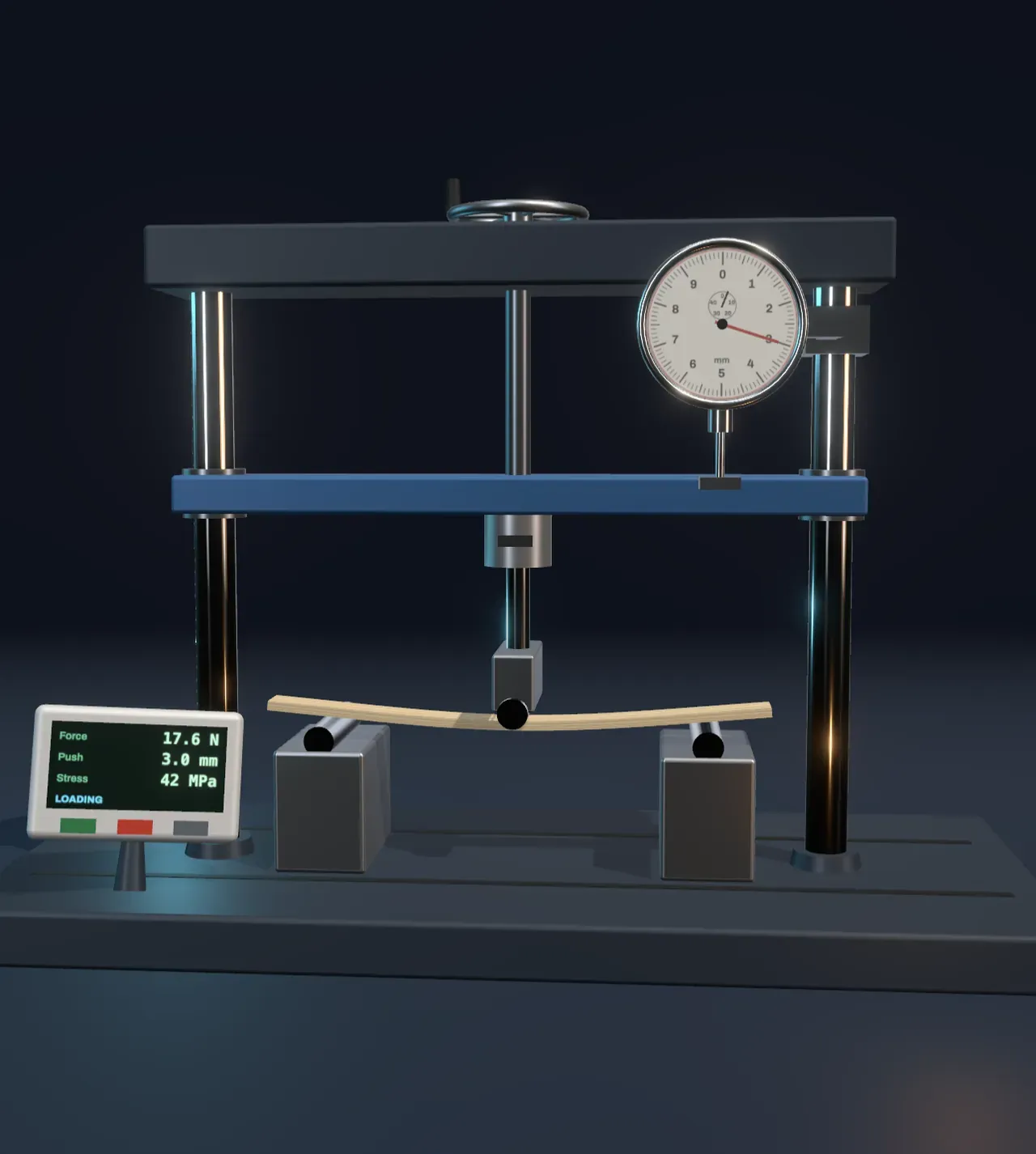
The Scene shows a strip of spruce resting on two rollers, with a nose pressing down on its middle. Raise Push until the wood breaks, and read the stress, the force on each unit of area, on the stretched underside.
Step 2 of 5
Across the grain
Wood is a bundle of long, hollow cells, like drinking straws glued side by side. Zoom to the molecules at the Micro stop shows which way the cells run. Along the grain the pull is carried by the cell walls, made of cellulose. Across the grain it only has to tear the thin layer of glue between the cells, a brownish polymer called lignin.
Predict what happens to the force needed to bend the wood by the same push when you switch Grain to Across.
Step 3 of 5
Levels within levels
The Scene shows Bone, with Zoom to the molecules at Nano. Every natural material is built in levels, each a composite of the level below. Bone has osteons, tubes of bone in rings round a blood vessel; inside them fibrils of collagen, with flat crystals of calcium phosphate between the molecules; and at the bottom the collagen molecule, three protein chains wound into a rope.
Step through Micro, Nano and Molecules, and think about which part carries the load and which passes it on.
Step 4 of 5
Stopping cracks
Strength is not the whole story. A material also has to be tough: hard to break once it has a crack. Glass is strong but not tough: a crack, once started, runs straight through. The Scene shows Nacre after it has broken, at the Micro stop: a wall of tiny mineral bricks, half a micrometre thick, in a mortar of protein and chitin. Look at the path the crack took.
Step 5 of 5
Light as well as strong
What matters for a tree, a bird’s wing bone or a spider’s web is strength for its weight. Divide a material’s strength by its density and you get its strength per kilogram, charted beside the Scene. For mild steel, with a strength of 430 MPa and a density of 7.85 g/cm³, it is about 55 kN·m/kg.
Engineers copy these ideas today, in a field called biomimetics: plywood and carbon-fibre composites lay their fibres along the load, and layered ceramics imitate nacre.
Loading the interactive version…
Loading the interactive version…
Each step sets up the Scene for you, and a control marked “fixed” stays put for that step.
Practice · Calculate
Raise Push until the spruce strip breaks. At what stress, on the stretched face, does it break?
Practice · Calculate
Raise Push until the spruce strip breaks. At what stress, on the stretched face, does it break?
Practice · Predict, then look
At the same push, 3 mm, switch Grain to Across. What happens to the force needed to bend the wood?
Practice · Predict, then look
At the same push, 3 mm, switch Grain to Across. What happens to the force needed to bend the wood?
Practice · Choose
Bone holds tiny crystals of mineral and fibres of protein, collagen. Which does what?
Practice · Choose
Bone holds tiny crystals of mineral and fibres of protein, collagen. Which does what?
Practice · Choose
Nacre is 95% mineral, yet it takes roughly a thousand times more energy to break than a plain crystal of the same mineral. Why?
Practice · Choose
Nacre is 95% mineral, yet it takes roughly a thousand times more energy to break than a plain crystal of the same mineral. Why?
Practice · Calculate
Spruce breaks along the grain at 75 MPa, and its density is 0.45 g/cm³. What is its strength per kilogram, in kN·m/kg (megapascals per g/cm³)?
Practice · Calculate
Spruce breaks along the grain at 75 MPa, and its density is 0.45 g/cm³. What is its strength per kilogram, in kN·m/kg (megapascals per g/cm³)?
Lesson complete. Every practice question here is done.