A short list of ingredients
Engineers can choose from almost any element and heat their materials to thousands of degrees. Living things cannot. They build at body temperature, in water, from what they can find or make, and the list of ingredients is short: a few sugars strung into chains, such as cellulose in plants and chitin in insects and shells; a few proteins, such as collagen, silk and keratin; and two common minerals, calcium carbonate (chalk) and calcium phosphate.
On their own these ingredients are poor. Chalk crumbles, gelatin (boiled collagen) is a wobbly jelly, and a lump of dried silk protein snaps like stale toffee. Yet a tree trunk holds up tonnes in a gale, a thigh bone carries you down a flight of stairs, and an abalone shell survives the beak of a hungry octopus. The difference is not in what they are made of but in how it is arranged.
Strong along the grain
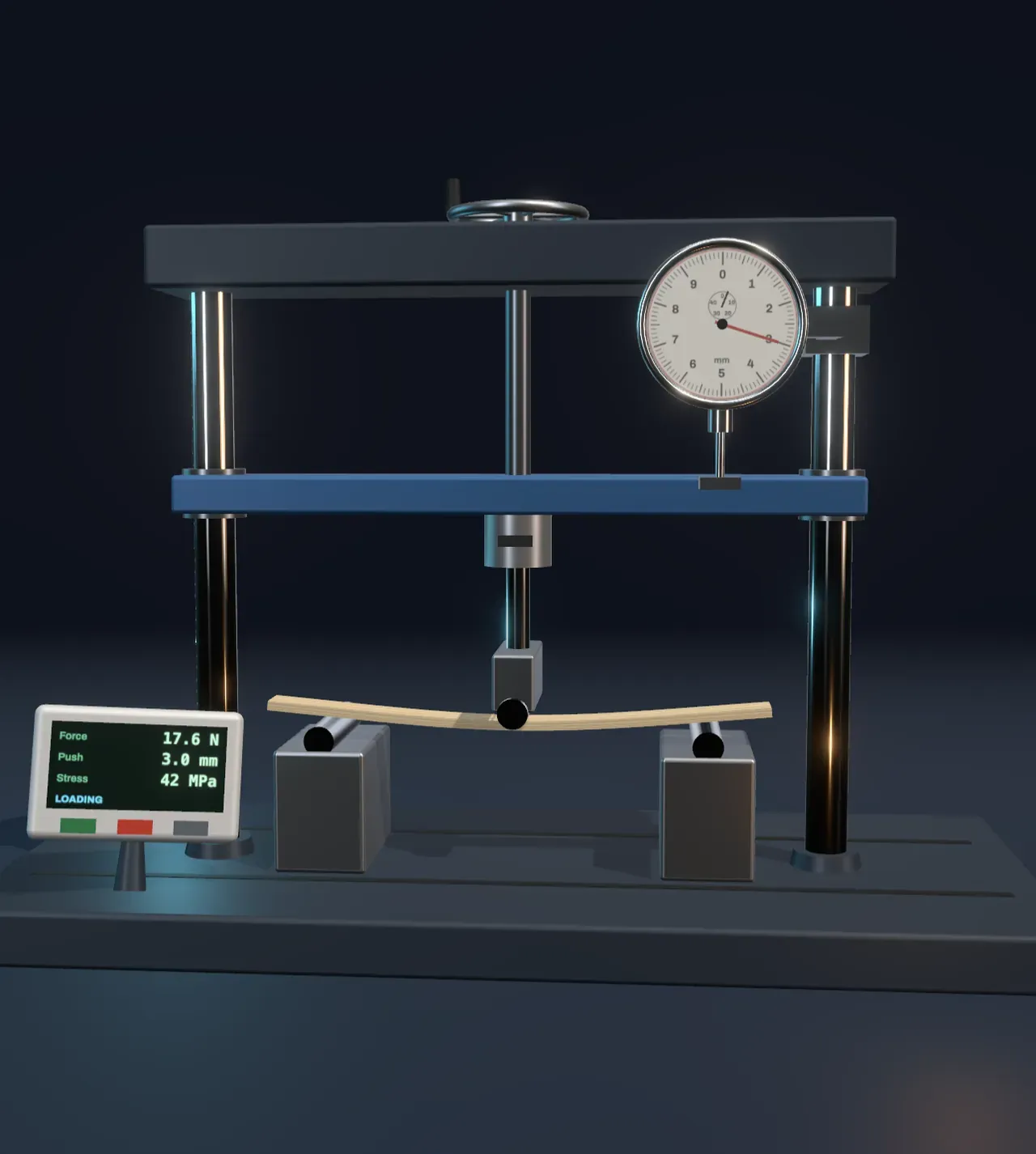
Choose Wood and push. A spruce strip bends, springs back if you let go, and breaks at a push of about 6 mm with a stress of 75 megapascals on its stretched underside. Now switch Grain to Across and try again. The same wood, cut the other way, takes about a fifteenth of the force to bend and snaps at a twentieth of the stress.
Try it: choose Wood, set Push to 10 mm and compare Along with Across. Then step Zoom to the molecules to Micro and see which way the cells run.
Wood is a bundle of long, hollow cells, like drinking straws glued side by side. Along the grain the pull is carried by the cell walls themselves, which are made of cellulose, one of the stiffest natural polymers. Across the grain the pull only has to tear the thin layer of glue between the cells, a brownish polymer called lignin. A tree does not need much strength across its trunk, so it does not spend material there. Bone does the same: its strength runs along the bone, the way it is loaded when you stand and walk.
Levels within levels
Step Zoom to the molecules through Micro, Nano and Molecules. Each material is built in levels, every level a composite of the one below. In wood, each cell wall is wound from fine fibrils of cellulose, laid at a different angle in each layer like the plies of plywood; in the thickest layer they spiral at only 10 to 20 degrees to the cell’s length, so they take the pull nearly straight. Each fibril is a crystal of cellulose chains held side by side by hydrogen bonds, the same weak attraction that holds water together, repeated millions of times.
Bone runs from osteons, tubes of bone in rings round a blood vessel, to fibrils of collagen protein with flat crystals of calcium phosphate in regular gaps between the molecules, to the collagen molecule itself, three protein chains wound into a rope. Nacre, or mother-of-pearl, is a brick wall of mineral tablets half a micrometre thick in a mortar of protein and chitin. Silk is a bundle of fibrils, each a tangle of protein chains studded with tiny crystals.
A hierarchy puts each ingredient where it does the most good. The stiff, brittle part (a crystal, a mineral tablet) carries the load, the soft part (a protein, a polymer glue) passes it from one stiff piece to the next, and the pieces are kept so small that they contain almost no flaws. A crystal of mineral a few nanometres thick is nearly as strong as a perfect one, which is why it does not matter that chalk itself is weak.
Stopping cracks
Strength is not the whole story. A material also has to be tough: hard to break once it has a crack. Glass is strong but not tough, because a crack, once started, runs straight through. Push Nacre until it breaks and look at Micro. The crack cannot cut through the tablets, so it zigzags round them, pulling tablets out against the glue and stretching strands of protein across the gap. Nacre is 95% mineral, yet it takes roughly a thousand times more energy to break than a plain crystal of the same mineral.
Try it: choose Nacre, push to 10 mm, and step Zoom to the molecules to Nano and then Molecules. The tablets slide on their glue, and the protein’s loops open one at a time.
Bone uses the same trick. Past about 0.7% stretch, tiny cracks open inside it and stop at the cement lines round each osteon, so the strip keeps bending and soaks up energy before it breaks. The protein strands themselves add a last layer: they are folded into loops held shut by weak “sacrificial” bonds, which break and let out hidden length long before the strand itself snaps, and can form again afterwards.
Light as well as strong
What matters for a tree, a bird’s wing bone or a spider’s web is strength for its weight. Divide a material’s strength by its density and you get its strength per kilogram, charted beside the Scene. Spruce, at 0.45 grams per cubic centimetre, beats mild steel about three times over. Spider silk beats it about fifteen times: a dragline thread breaks at 1100 megapascals and weighs only a sixth as much. Choose Spider silk and slide Push all the way to 40 mm. The thread is stiff at first, then its chains unfold and it stretches by a quarter before it snaps, absorbing more energy per kilogram than the fibres in a bulletproof vest.
Grown, not made
Natural materials are made at room temperature from water, sugar, air and a little dissolved mineral, and many of them repair themselves. Bone is remodelled all the time: cells dissolve old bone and lay down new osteons where the loads are greatest, which is why astronauts lose bone in orbit and tennis players have thicker bones in their racket arm. Trees grow extra wood on the side of a leaning trunk.
Engineers now copy these ideas, a field called biomimetics: plywood and carbon-fibre composites put fibres where the load goes, layered ceramics imitate nacre, and laboratories spin artificial spider silk from proteins made by bacteria. Compare the engineered materials in Materials technology, the chains of Polymers and plastics, the ordered atoms of Crystals and how proteins fold in Proteins and folding.
What this model leaves out
Each curve is a typical value; real wood, bone, shell and silk vary several times over with species, age, how fast they grew and how wet they are, and all four are tested wet in nature, where they are softer and tougher than dry. The beam formula for the stress on the stretched face assumes small, springy bends; past the elastic limit, and at the large bends of bone, it is only approximate, and the force on the nose comes from the same formula. A strip of wood or bone squeezed on its top face also crumples there, which the model folds into one curve. The silk thread is assumed taut at the start and its supports frictionless. The magnified views are idealised: real wood has rays and resin canals, bone has many cells and vessels, and the protein loops in nacre and the order of molecules in silk are still being studied.