Two almost identical double pendulums: motion fixed completely by its start that still cannot be predicted, a tiny gap that grows by multiplying, and why more precision buys very little time.
Step 1 of 4 · The same start
Step 1 of 4
The same start
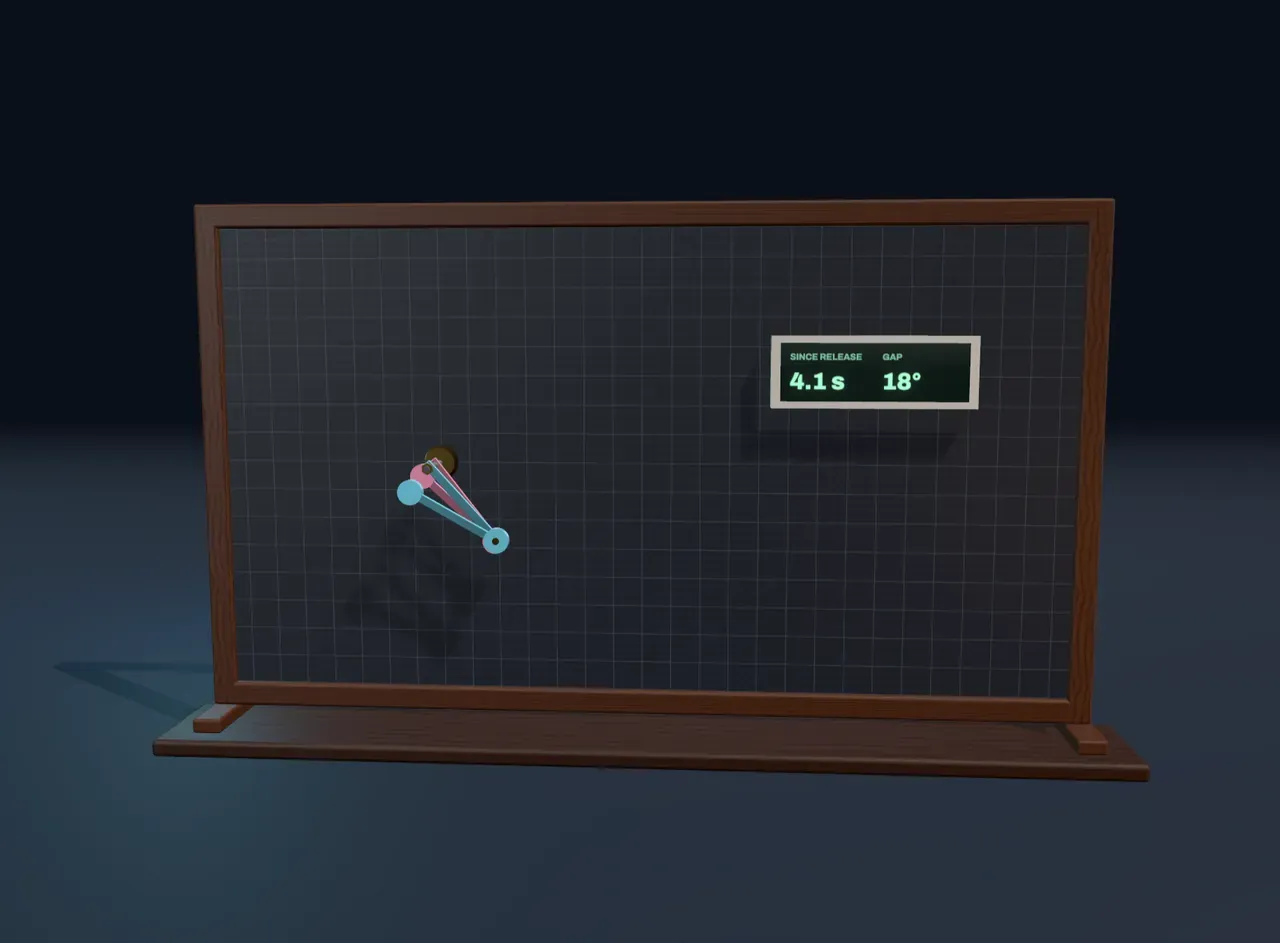
A double pendulum is a rod hanging from a pivot, with a second rod hanging from its end. The scene has two, a blue one in front and a pink one behind it, built exactly alike and released together from . Their motion is computed from Newton’s laws, with no dice anywhere.
Step 2 of 4
A tiny gap
Now the pink one starts further round, a difference you cannot see. Show the paths shows each pendulum’s path, and a chart of the gap between them on a log scale: each square up is ten times more. On the board a timer shows the time since release and the gap now.
Step 3 of 4
Ten times the precision
On the chart the gap climbs in an almost straight line. On a log scale a straight line means exponential growth: in each fixed stretch of time the gap is multiplied by the same number. A system in which tiny differences grow like this is called chaotic, and this dependence on the start is called the butterfly effect.
Step 4 of 4
A gentle release
Not every motion of a double pendulum is chaotic. The Release angle is free now.
Try it: after checking, find roughly the angle at which the motion turns from regular to chaotic. The chart will tell you.
Loading the interactive version…
Loading the interactive version…
Each step sets up the Scene for you, and a control marked “fixed” stays put for that step.
Practice · Predict, then look
The Difference in start angle is zero: both pendulums are released from exactly the same angle. What will happen during the run?
Practice · Predict, then look
The Difference in start angle is zero: both pendulums are released from exactly the same angle. What will happen during the run?
Practice · Calculate
The pink one starts further round. Watch the timer on the board: after how many seconds does the gap between the pendulums reach ?
Practice · Calculate
The pink one starts further round. Watch the timer on the board: after how many seconds does the gap between the pendulums reach ?
Practice · Predict, then look
Now the starting gap is made ten times smaller, . When will the gap reach ?
Practice · Predict, then look
Now the starting gap is made ten times smaller, . When will the gap reach ?
Practice · Predict, then look
The pair is released low, from , with the same gap of . What will happen to the gap during the 20-second run?
Practice · Predict, then look
The pair is released low, from , with the same gap of . What will happen to the gap during the 20-second run?
Lesson complete. Every practice question here is done.