A sequence that adds the same number at every step: the general term, how to find the difference, how Gauss added the numbers from 1 to 100 in pairs, and why the odd numbers always add up to a square.
Step 1 of 5 · Add the difference
Step 1 of 5
Add the difference
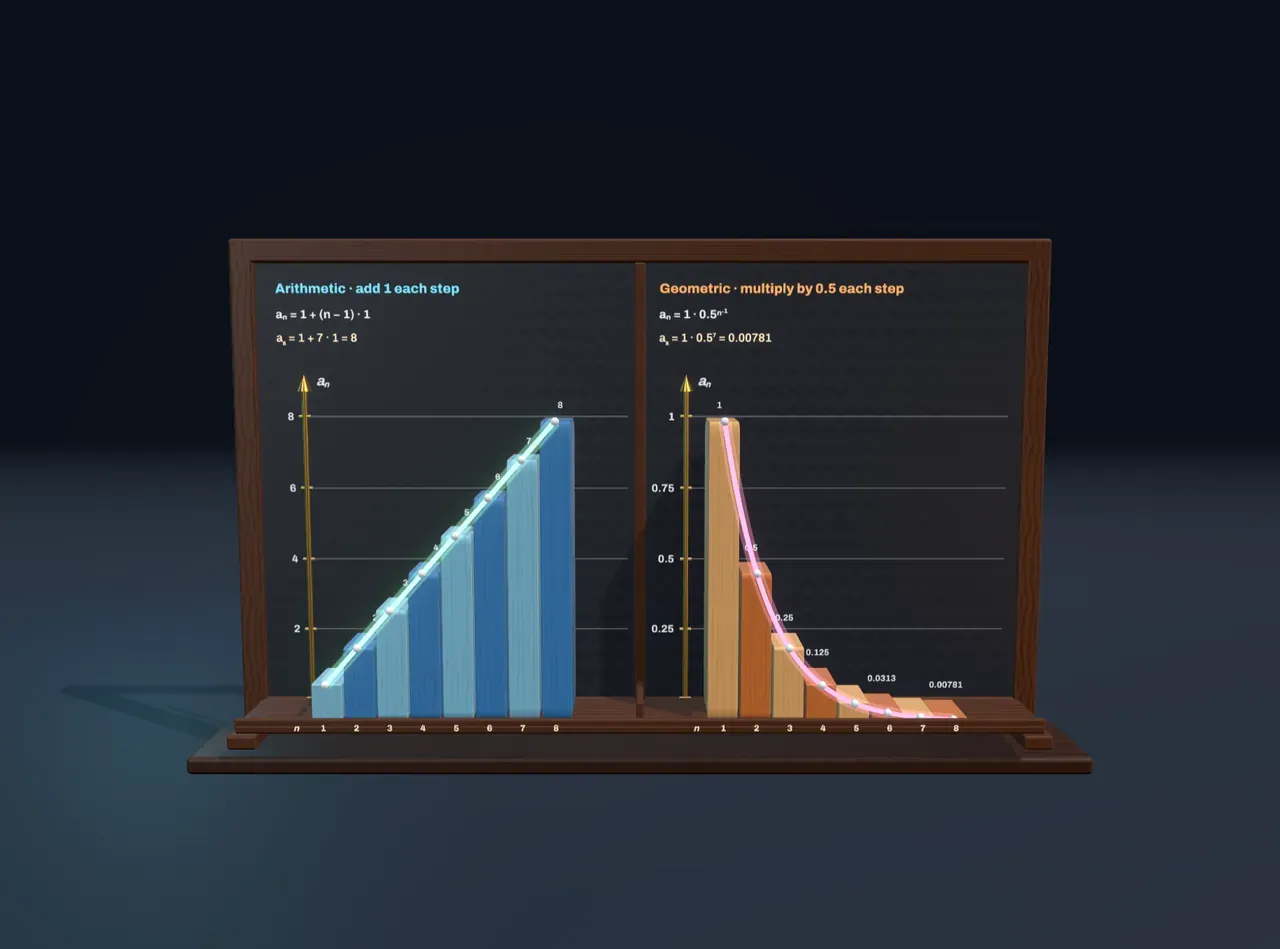
A sequence is a list of numbers in order: is the first term, the second, and so on. In an arithmetic sequence each term is more than the one before by the same number, the difference : . On the board each term is a column of blocks, and the arithmetic sequence is the staircase on the left. Here and Difference d is , and only the first term is shown. Predict the first five terms.
Step 2 of 5
The general term
To reach the th term you need not go through every term before it. From the first term to the th there are steps, and each step adds :
This formula is a linear function of , as in the linear functions Unit: the difference is the slope, which is why the column tops climb in a straight line. Terms n is locked at ; find the difference that gives a particular eighth term.
Step 3 of 5
Terms far away
With the formula you can jump straight to a far-off term, even though the board shows only ten. In the sequence of odd numbers, and , the tenth term is , the number above the last column. Work out a much later term the same way.
Step 4 of 5
Adding in pairs
What is ? A famous story says Carl Friedrich Gauss solved it as a boy in minutes: he added the first and the last, , the second and the second to last, , and so on. There are such pairs, so the sum is .
The same idea works for any arithmetic sequence, because every “first plus last” pair is equal. Write for the sum of the first terms:
Here the sequence is . Work out , then move Add the terms to the running totals: each column lifts onto itself every term before it and shows the running total.
Step 5 of 5
Odd numbers and squares
The board shows the running totals of the odd numbers: , , . The totals do not climb in a straight line but in a curve: they are squares. Move Terms n to find how many odd numbers add up to .
Loading the interactive version…
Loading the interactive version…
Each step sets up the Scene for you, and a control marked “fixed” stays put for that step.
Practice · Predict, then look
and . What are the first five terms of the sequence?
Practice · Predict, then look
and . What are the first five terms of the sequence?
Practice · Reach the target
and are locked. Change Difference d so that the eighth term is , then press Check.
Practice · Reach the target
and are locked. Change Difference d so that the eighth term is , then press Check.
Practice · Calculate
In the sequence of odd numbers, and . The board shows only ten terms. What is the th term?
Practice · Calculate
In the sequence of odd numbers, and . The board shows only ten terms. What is the th term?
Practice · Calculate
, and : the board shows . Add them by pairing: what is ? Answer, then move Add the terms to the running totals.
Practice · Calculate
, and : the board shows . Add them by pairing: what is ? Answer, then move Add the terms to the running totals.
Practice · Reach the target
The sequence is the odd numbers, and , and the board shows the running totals. Change Terms n so that the sum is , then press Check.
Practice · Reach the target
The sequence is the odd numbers, and , and the board shows the running totals. Change Terms n so that the sum is , then press Check.
Lesson complete. Every practice question here is done.