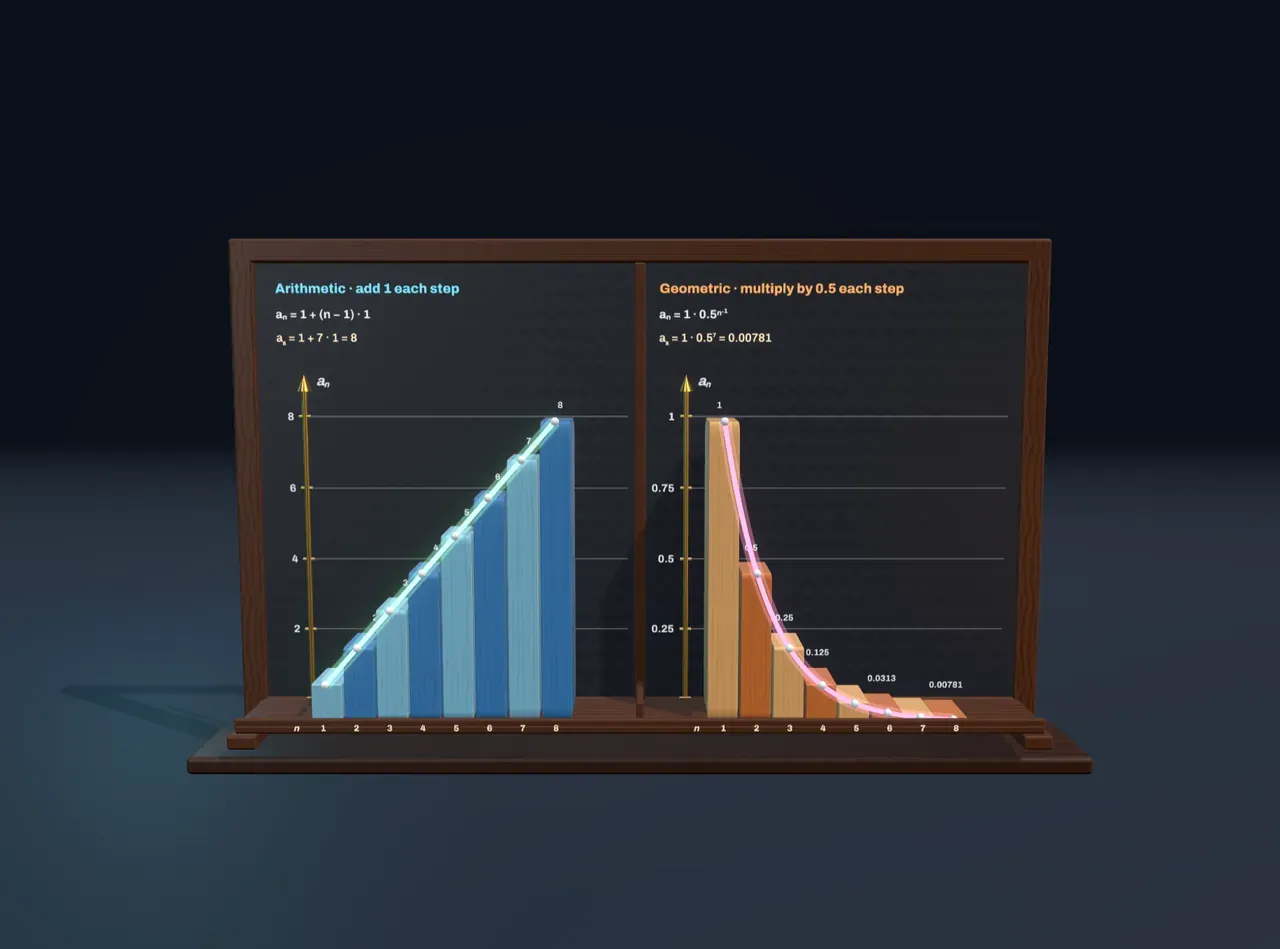
Two kinds of staircase
A sequence is a list of numbers in order: a first term, a second, a third, and so on, written a₁, a₂, a₃, …, with aₙ for the term in place n. The board builds each term as a column of blocks, so a sequence becomes a staircase.
The two simplest sequences are made by repeating one move. In an arithmetic sequence you add the same number every time, the common difference d. Start at 1 and add 2 and you get 1, 3, 5, 7, the odd numbers. In a geometric sequence you multiply by the same number every time, the common ratio q. Start at 1 and multiply by ½ and you get 1, ½, ¼, ⅛. Each has a rule that jumps straight to any term without listing the ones before:
- arithmetic: aₙ = a₁ + (n − 1)·d
- geometric: aₙ = a₁·qⁿ⁻¹
The left staircase is arithmetic, so every step is the same height above the last and a line through the tops is straight: the sequence is a linear function read at the whole numbers. The right staircase is geometric, so every step is the same fraction of the last and the line through the tops bends. With q above 1 it curves up faster and faster, the exponential growth of doubling bacteria or compound interest. With q below 1 it falls in a curve that flattens towards zero without ever reaching it.
Adding them up
A series is what you get by adding the terms of a sequence. The running total of the first n terms is written Sₙ: S₁ = a₁, S₂ = a₁ + a₂, and so on. Step Add the terms to Running totals and each column lifts its newest block onto copies of every block before it, so column n is Sₙ tall.
There is a well-known story that the young Carl Friedrich Gauss, set to add the numbers from 1 to 100 to keep him busy, answered at once. Pair the first number with the last, 1 + 100, then the second with the second to last, 2 + 99, and so on: every pair makes 101, and there are 50 pairs, so the total is 5,050. Whether or not it happened that way, the trick works for any arithmetic sequence. Turn a copy of the staircase upside down and lay it on the original, and the two fit together into a rectangle n columns wide and a₁ + aₙ tall. The staircase is half of it:
Sₙ = n·(a₁ + aₙ) / 2
Because Sₙ grows like n², the tops of the running totals curve upward, a parabola, even though the terms themselves sat on a straight line. Set Difference d to 2, the odd numbers, and the running totals are 1, 4, 9, 16, 25: the sum of the first n odd numbers is always n².
The geometric sum
Geometric sums have their own trick. Write the sum S = a₁ + a₁q + a₁q² + … + a₁qⁿ⁻¹ and multiply it by q. Every term moves one place along, so qS and S share all but two terms; subtract and almost everything cancels, leaving qS − S = a₁qⁿ − a₁. So
Sₙ = a₁·(qⁿ − 1) / (q − 1), for q ≠ 1.
When q is 2 the total after n steps is 2ⁿ − 1, one less than the next term: each doubling adds more than everything before it. The old tale of the inventor of chess, who asked for one grain of rice on the first square, two on the second, four on the third and so on, ends with 2⁶⁴ − 1 grains, more rice than has ever been grown.
An endless sum with a total
Now let the terms go on for ever. An arithmetic sequence that climbs, or even stays flat, can never have a total: every new term adds at least as much as the first, so the sum passes any number you name. The same is true of a geometric sequence with q of 1 or more. Such a series diverges.
But when q is between 0 and 1, the terms shrink so fast that their sum closes in on a fixed number and never passes it. Walk half the way to a wall, then half of what is left, then half of that: ½ + ¼ + ⅛ + … never takes you through the wall, and never stops getting closer. In the formula, qⁿ shrinks towards zero as n grows, so the total of all the terms is
S = a₁ / (1 − q)
and the series converges to S. With a₁ = 1 and q = ½ that is 2. Repeating decimals are series like this: 0.999… is 9/10 + 9/100 + 9/1000 + …, a geometric series with a₁ = 0.9 and q = 0.1, and its total is 0.9 / 0.9, exactly 1.
Try it: set Ratio q to 0.5 and step Add the terms to Forever. The glass case is 2 tall, and the eight blocks pour in and fill all of it but a sliver of 1/128. Slide Terms n down to 1: one block fills half the case and the glowing rest is the other half. Slide it back up and the running totals climb towards the dashed line, each closing half the gap that is left. Set Ratio q to 0.9 and they are still far below it after ten terms; at 1 the case becomes an open tube with no top.
Shrinking terms are needed for a total, but they are not enough. The harmonic series, 1 + ½ + ⅓ + ¼ + …, has terms that shrink towards zero, yet it has no total: group its terms as ½, then ⅓ + ¼, then ⅕ to ⅛, and each group is more than ½, so the sum grows past any number, only very slowly. Nicole Oresme showed this around 1350. A geometric series converges because each term is a fixed fraction of the last: everything left after n terms is then a fixed multiple of the next term, and the terms shrink to nothing.
Where series turn up
A savings plan that adds the same amount every month, each deposit then earning interest, is a geometric series, and so is the repayment schedule of a mortgage. The total distance a bouncing ball travels before it comes to rest is a geometric series when each bounce reaches a fixed fraction of the one before. The ancient puzzle of Zeno, in which swift Achilles can never catch a tortoise because he must first reach where it was, is answered by a converging series of shorter and shorter times. And the area under a curve in calculus is defined as the limit of sums of thinner and thinner slices. Not every famous sequence is one of these two kinds: in the Fibonacci numbers each term is the sum of the two before, and the ratio between neighbours settles on the golden ratio, which shapes the spirals in a sunflower.
What this model leaves out
Both staircases start at 1. Changing a₁ would multiply every term and every sum by the same factor, so it would change the numbers on the rulers but not the shapes. The difference only goes up from 0, and the ratio is never negative: a falling arithmetic sequence would drop below zero, and a negative ratio makes the terms alternate in sign, which a staircase of blocks cannot show. A geometric series with q between −1 and 0 still converges, to the same a₁ / (1 − q).
Only ten terms are drawn. The glass case is not built from infinitely many blocks; its height is computed from the formula, and the glowing remainder is everything after the last term drawn, aₙ₊₁ / (1 − q) in all. Each ruler is fitted to its own tallest column, so the two halves of the board are not drawn to the same scale. Convergence itself has a precise definition, that the running totals get and stay as close to the limit as anyone demands, which this page only describes in words.