A sequence that multiplies by the same number at every step: the general term, how to find the ratio, the sum of the first n terms, and why in the end it overtakes any arithmetic sequence.
Step 1 of 5 · Multiply by the ratio
Step 1 of 5
Multiply by the ratio
In a geometric sequence each term is the one before multiplied by the same number, the ratio : . This is exponential growth from the exponents Unit, written as a list. On the board it is the staircase on the right. Here and Ratio q is . Predict the first six terms.
Step 2 of 5
The general term and the ratio
From the first term to the th there are steps, and each step multiplies by :
Here the first term is , and Terms n is locked at . Find the ratio that gives . A hint from the exponents Unit: two steps of multiplying by are a multiplication by .
Step 3 of 5
A sum of powers of 2
The sum of a geometric sequence takes a different trick. Write the sum, , and under it : the same terms, each moved along one place. Subtract, and almost everything cancels, leaving :
The formula works for any . Here : work out , then move Add the terms to the running totals.
Step 4 of 5
A sum of halves
When the terms shrink, and it is easier to write the same formula with both signs turned round: . Here , each term half the one before. Work out the sum of the first six terms.
Step 5 of 5
Which one wins
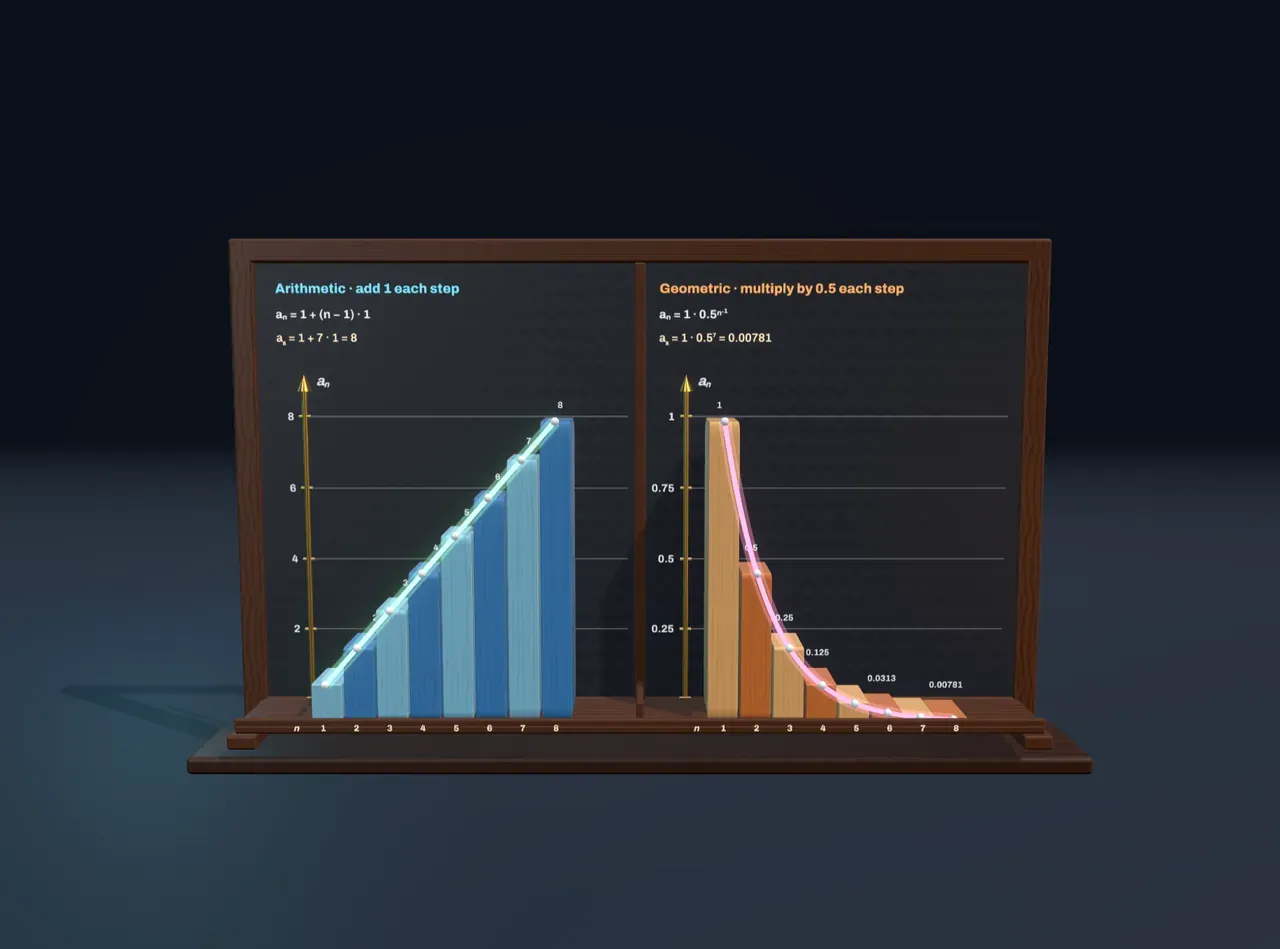
The board now shows both sequences, both from : on the left you add , on the right you multiply by . Over the first four terms the arithmetic one is well ahead. Predict which will be bigger at the tenth term, then move Terms n and check.
Loading the interactive version…
Loading the interactive version…
Each step sets up the Scene for you, and a control marked “fixed” stays put for that step.
Practice · Predict, then look
and . What are the first six terms?
Practice · Predict, then look
and . What are the first six terms?
Practice · Reach the target
Here the first term is , and is locked. Change Ratio q so that the third term is , then press Check.
Practice · Reach the target
Here the first term is , and is locked. Change Ratio q so that the third term is , then press Check.
Practice · Calculate
, and . What is ? Answer, then move Add the terms to the running totals.
Practice · Calculate
, and . What is ? Answer, then move Add the terms to the running totals.
Practice · Calculate
, and : . What is ? Answer, then move Add the terms to the running totals.
Practice · Calculate
, and : . What is ? Answer, then move Add the terms to the running totals.
Practice · Choose
On the left and ; on the right and . At the arithmetic sequence is ahead: against . Which will be bigger at the tenth term?
Practice · Choose
On the left and ; on the right and . At the arithmetic sequence is ahead: against . Which will be bigger at the tenth term?
Lesson complete. Every practice question here is done.