What happens when you add terms forever: why a half plus a quarter plus an eighth adds up to exactly 2, the formula for the sum of a convergent geometric series, when there is no finite sum, and why 0.999… equals 1.
Step 1 of 5 · Halves forever
Step 1 of 5
Halves forever
To cross a room you must first cover half of it, then half of what is left, then half of what is left again. Zeno of Elea argued that no one can take infinitely many steps, so no one can cross the room. But the steps are long, and a sum like that can end in a finite number.
On the board and , and Add the terms stands at the running totals: , , , Predict the sum if you keep adding forever.
Step 2 of 5
The formula for the endless sum
An endless sum is the number the running totals close in on as grows. In the formula , when the power shrinks to zero, leaving:
The series is said to converge. Here the first term is and . Work out the endless sum, then move Add the terms to Forever: the glass case is as tall as the sum, and the terms fill it exactly.
Step 3 of 5
Close to 1
The closer is to , the more slowly the terms shrink, and the bigger the sum: , . Find the ratio that gives an endless sum of .
Step 4 of 5
When there is no total
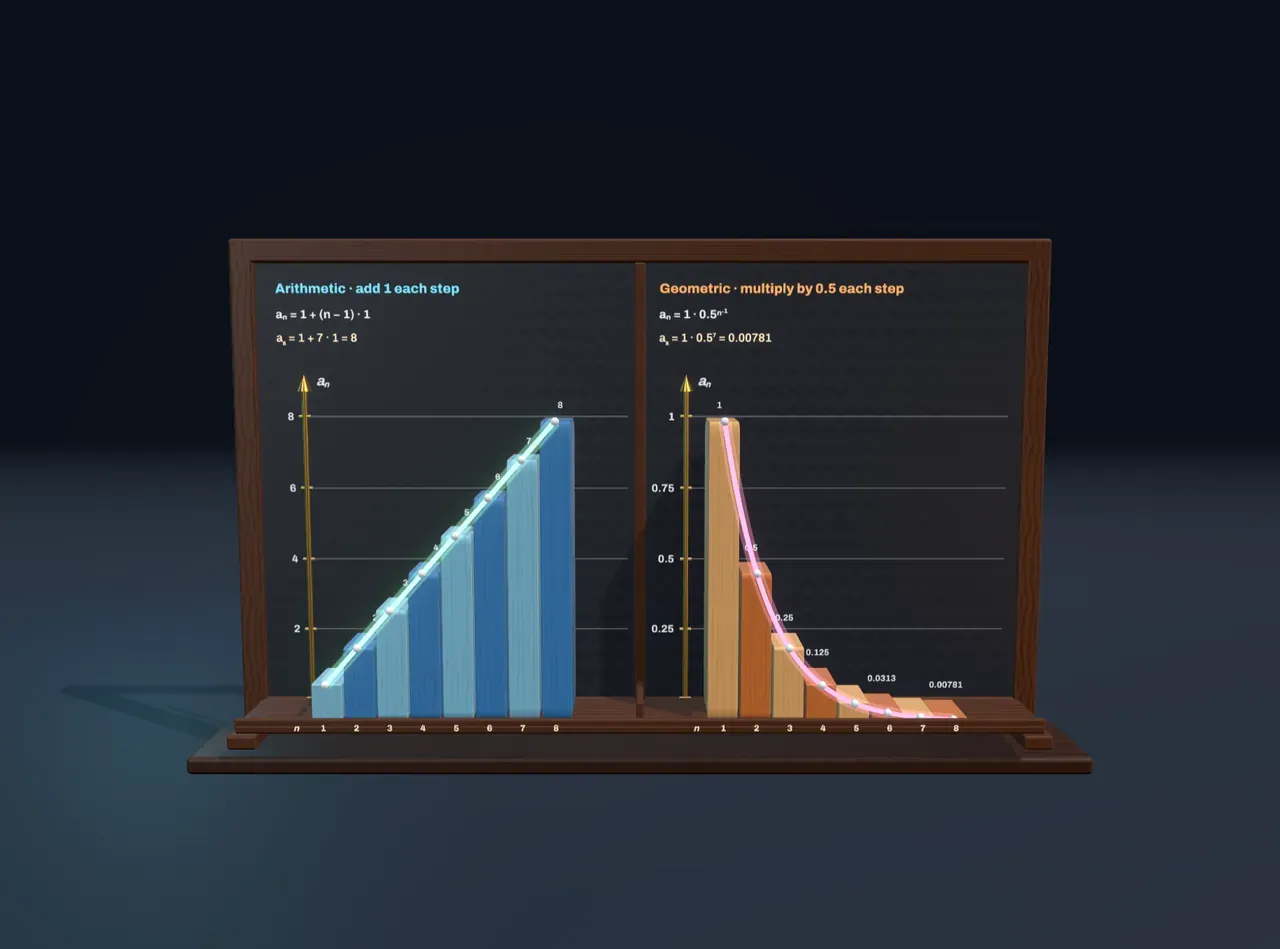
Not every series has a sum. When every term equals , and terms make : the sum grows without limit. When it grows faster still. A rising arithmetic sequence has no endless sum either. On the board the glass case is open at the top, with an arrow: no total. Try a few values of Ratio q and Difference d, then answer.
Step 5 of 5
0.999… = 1
The decimal , with nines for ever, is a series: , with and . Here the board shows four terms; the columns are already almost level. Work out the endless sum, then move Add the terms to Forever.
Loading the interactive version…
Loading the interactive version…
Each step sets up the Scene for you, and a control marked “fixed” stays put for that step.
Practice · Predict, then look
and . The board shows the running totals of ten terms. If you keep adding forever, , what is the sum?
Practice · Predict, then look
and . The board shows the running totals of ten terms. If you keep adding forever, , what is the sum?
Practice · Calculate
Here the first term is and : . What is the endless sum? Answer, then move Add the terms to Forever.
Practice · Calculate
Here the first term is and : . What is the endless sum? Answer, then move Add the terms to Forever.
Practice · Reach the target
. Change Ratio q so that the endless sum is , then press Check.
Practice · Reach the target
. Change Ratio q so that the endless sum is , then press Check.
Practice · Choose
Which of these endless sums have a finite total? Select all that do.
Practice · Choose
Which of these endless sums have a finite total? Select all that do.
Practice · Calculate
is : a geometric series with and . What is its sum? Answer, then move Add the terms to Forever.
Practice · Calculate
is : a geometric series with and . What is its sum? Answer, then move Add the terms to Forever.
Lesson complete. Every practice question here is done.