Snow that outlasts the summer piles up into ice, and the ice flows like a very slow river. See how the summer sets an ice sheet's size, where the ice flows fastest, how far it pushes the ground down and how much water it takes from the sea.
Step 1 of 6 · Snow that outlasts the summer
Step 1 of 6
Snow that outlasts the summer
A glacier starts as snow that does not melt. Snow buried under the next years’ snow is squeezed: the flakes round into grains, the grains weld into firn, and some tens of metres down the firn turns into solid glacial ice, with the old air trapped in it as bubbles.
The Scene is an ice sheet on a northern continent, cut through its summit, 2,800 km across, with heights drawn times their true size. The climate warms steadily to the south, on the left. For each climate the Scene shows the ice sheet whose yearly snowfall and melt balance. The Summer temperature is the temperature on the coast.
Step 2 of 6
A budget of snow
Every glacier keeps a budget. Up high, in the accumulation zone, snowfall wins and the ice thickens. Lower down, in the ablation zone, the summer melts more than fell. The line between them, where a year’s snow and melt just balance, is the equilibrium line. In the Unit on the atmosphere we saw that air cools about 6.5 °C for each kilometre, so the high middle of an ice sheet stays cold even in summer. The Summer temperature is now −1 °C.
Step 3 of 6
Solid ice flows
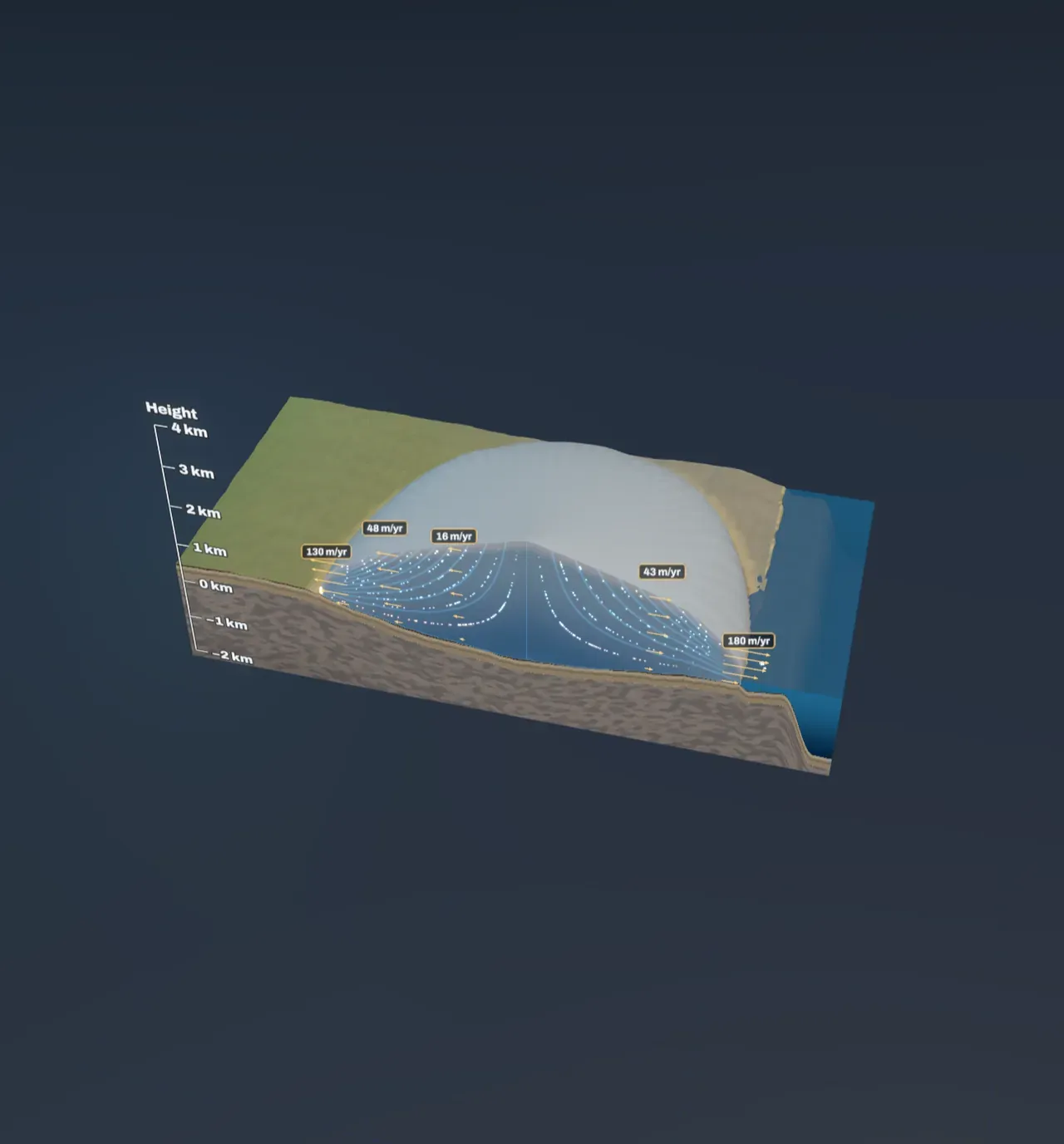
Step Look under the ice to Flow inside. The arrows give the ice’s speed at five depths; the dots are parcels of snow moving with the ice, white when the snow is fresh, blue after thousands of years and amber after tens of thousands. On the left they come back to the surface in the ablation zone and melt; on the right they reach the sea in icebergs.
Step 4 of 6
The ground sinks
The Earth’s crust floats on the mantle, which over thousands of years flows like a very thick fluid. Look under the ice is at Under the ice, and the ground appears beneath the sheet.
Step 5 of 6
Water missing from the sea
Every tonne of ice on land is a tonne of water taken from the sea. It is now an Ice age, −2 °C on the coast.
Step 6 of 6
Floating ice
Today the sea is rising by about 4 mm a year: roughly half from melting glaciers and ice sheets, and most of the rest because sea water expands as it warms. But not all melting ice raises the sea.
Loading the interactive version…
Loading the interactive version…
Each step sets up the Scene for you, and a control marked “fixed” stays put for that step.
Practice · Predict, then look
The Summer temperature on the coast is at Today, 6 °C, and the Snowfall 0.35 m a year: there is no ice sheet, because every summer melts the winter’s snow. Move the summer temperature to Ice age, −2 °C, without changing the snow. What will happen?
Practice · Predict, then look
The Summer temperature on the coast is at Today, 6 °C, and the Snowfall 0.35 m a year: there is no ice sheet, because every summer melts the winter’s snow. Move the summer temperature to Ice age, −2 °C, without changing the snow. What will happen?
Practice · Reach the target
The Snowfall is locked at 0.35 m a year. Find the Summer temperature at which the ice sheet is about 1,000 km wide, and press Check.
Practice · Reach the target
The Snowfall is locked at 0.35 m a year. Find the Summer temperature at which the ice sheet is about 1,000 km wide, and press Check.
Practice · Choose
Look under the ice is at Flow inside. The arrows give the ice’s speed at five depths in a few places, and the dots are parcels of snow moving with the ice. Where does the ice flow fastest?
Practice · Choose
Look under the ice is at Flow inside. The arrows give the ice’s speed at five depths in a few places, and the dots are parcels of snow moving with the ice. Where does the ice flow fastest?
Practice · Calculate
Look under the ice is at Under the ice, and the climate is locked. The dashed line is where the ground would be with no ice. The ice over the divide is about 3.1 km thick, and its density about 917 kg/m³ against about 3300 kg/m³ for the mantle. By how many metres has the ground sunk under the divide?
Practice · Calculate
Ice age, and the climate is locked. Every tonne of ice on land is a tonne of water taken from the sea. The chart beside the Scene shows how much water the sheet takes. By how many metres does it lower the sea level across the whole world?
Practice · Calculate
Ice age, and the climate is locked. Every tonne of ice on land is a tonne of water taken from the sea. The chart beside the Scene shows how much water the sheet takes. By how many metres does it lower the sea level across the whole world?
Practice · Choose
The floating sea ice of the Arctic, and the floating ice shelves at the edge of Antarctica, are melting. What does that do to the sea level, compared with melting the same amount of ice resting on land?
Practice · Choose
The floating sea ice of the Arctic, and the floating ice shelves at the edge of Antarctica, are melting. What does that do to the sea level, compared with melting the same amount of ice resting on land?
Lesson complete. Every practice question here is done.