Angles are measured from the normal, light entering glass bends towards it, Snell's law, and light that cannot get out of the glass: the critical angle and total internal reflection.
Step 1 of 5 · An angle from the normal
Step 1 of 5
An angle from the normal
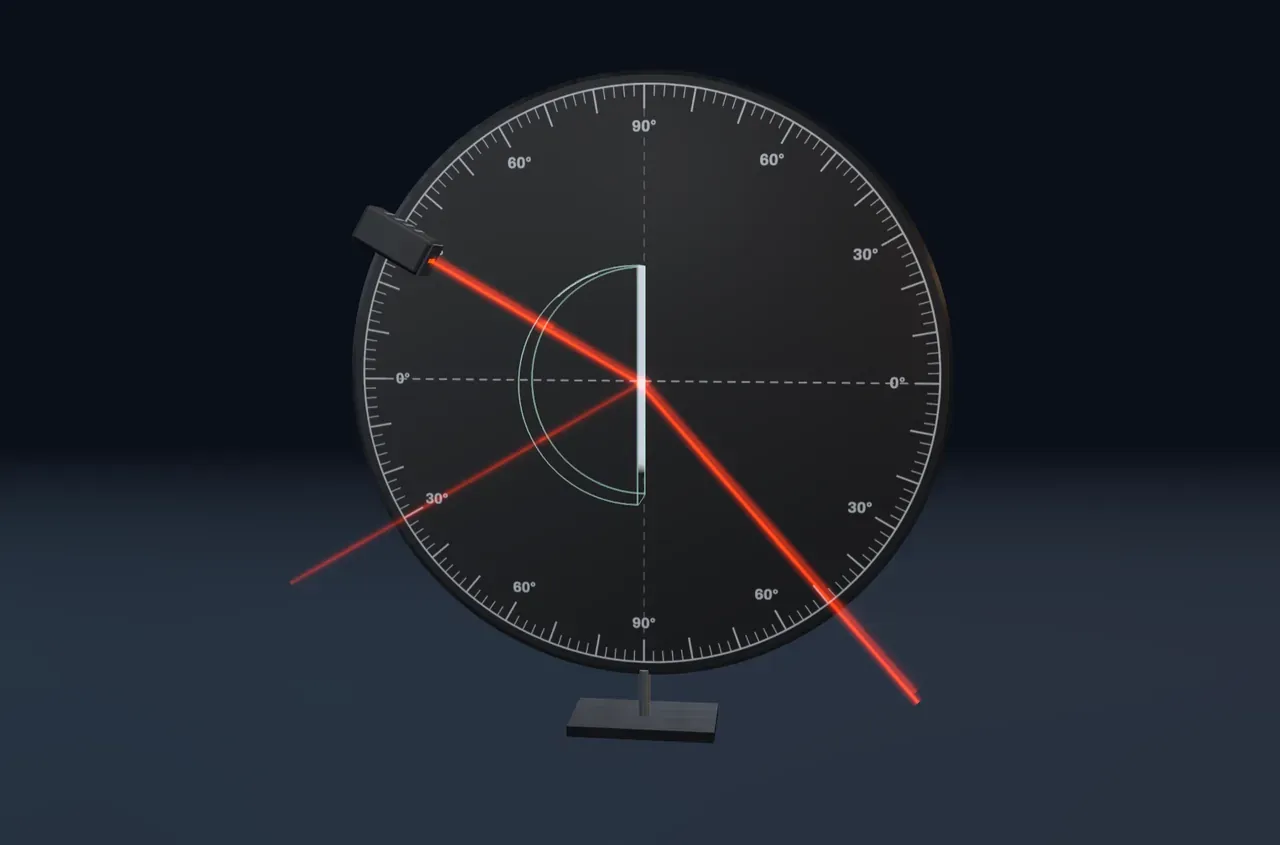
When a ray of light meets a surface, its direction is measured from the normal: an imaginary line square to the surface where the ray strikes. The angle between the arriving ray and the normal is the angle of incidence, and the angle between the ray that went into the material and the normal is the angle of refraction. Why not from the surface itself? Because a surface can be curved, like a lens or a water drop, while the normal has one clear direction at every point.
Some of the light does not go into the glass but reflects off it: that is the dim ray. It leaves on the other side of the normal, at the same angle the ray came in at. This is the law of reflection: the angle of reflection equals the angle of incidence, for any smooth surface, from glass to a mirror.
In the Scene the ray strikes a glass block, and the angle control is hidden. Answer, then choose On under Show normals and angles to check.
Step 2 of 5
Towards the normal
The ray now meets the glass head on, along the normal, and goes straight through without bending. What happens when it arrives at a slant?
Like any wave that passes from one medium into another, light changes speed at the boundary. In glass it is slower than in air. The refractive index of a material says how many times slower: , where is the speed of light in a vacuum (and very nearly in air) and its speed in the material. Glass has , so light crosses it at about 200,000 km/s instead of about 300,000 km/s.
Predict, then watch the Scene tilt the ray to .
Step 3 of 5
Snell’s law
The ray turns because one side of its wavefront enters the glass and slows before the other. The exact rule is Snell’s law:
and belong to the material the light comes from (in air ), and and to the one it enters. When is larger than , the sine of the angle of refraction is smaller, and so is the angle: the ray bends towards the normal. To find , work out first, then the angle with .
The angle, the glass and the direction are now fixed. Work out the angle of refraction, then check with Show normals and angles.
Step 4 of 5
Out of the glass
Now the light leaves the glass. It enters the curved side of the half-cylinder along a radius, so it does not bend there, and meets the flat side from within. Snell’s law works this way round too, with and :
The sine of the angle of refraction is larger than that of the angle of incidence, so the ray bends away from the normal: at it leaves at about . But what happens when would come out larger than ? Predict, then watch the Scene raise the angle to .
Step 5 of 5
The critical angle
The angle at which the refracted ray leaves exactly along the surface, , is the critical angle . From Snell’s law, , so:
Past the critical angle Snell’s law has no solution, and no light gets out: all of it reflects back inside, at an angle of reflection equal to the angle of incidence. This is total internal reflection. Optical fibres use it to carry light for kilometres, and diamond’s small critical angle, about , traps light inside it and makes it sparkle.
The disc is now made of water. Work out its critical angle, then raise the Angle of incidence slowly and find the angle at which the light stops getting out.
Loading the interactive version…
Loading the interactive version…
Each step sets up the Scene for you, and a control marked “fixed” stays put for that step.
Practice · Calculate
The ray strikes the glass block at an angle of to the surface of the glass. What is the angle of incidence?
Practice · Calculate
The ray strikes the glass block at an angle of to the surface of the glass. What is the angle of incidence?
Practice · Predict, then look
The ray passes from air into glass. When it is tilted so that the angle of incidence is , which way will it turn inside the glass?
Practice · Predict, then look
The ray passes from air into glass. When it is tilted so that the angle of incidence is , which way will it turn inside the glass?
Practice · Calculate
A ray of light in air strikes glass with a refractive index of , at an angle of incidence of . What is the angle of refraction?
Practice · Calculate
A ray of light in air strikes glass with a refractive index of , at an angle of incidence of . What is the angle of refraction?
Practice · Predict, then look
The light leaves the glass () for air. At an angle of incidence of it comes out at about . What will happen when the angle of incidence grows to ?
Practice · Predict, then look
The light leaves the glass () for air. At an angle of incidence of it comes out at about . What will happen when the angle of incidence grows to ?
Practice · Calculate
The refractive index of water is . What is the critical angle for light going from water into air?
Practice · Calculate
The refractive index of water is . What is the critical angle for light going from water into air?
Lesson complete. Every practice question here is done.