The photoelectric effect: a threshold frequency that brightness cannot get past, the energy of a photon, the work function, the stopping voltage, and the speed of the fastest electron.
Step 1 of 7 · A puzzle
Step 1 of 7
A puzzle
In the light Unit we saw that light is an electromagnetic wave. In the wave picture, brighter light shakes the electrons in a metal harder, so light that is bright enough, of any colour, should knock electrons out of it.
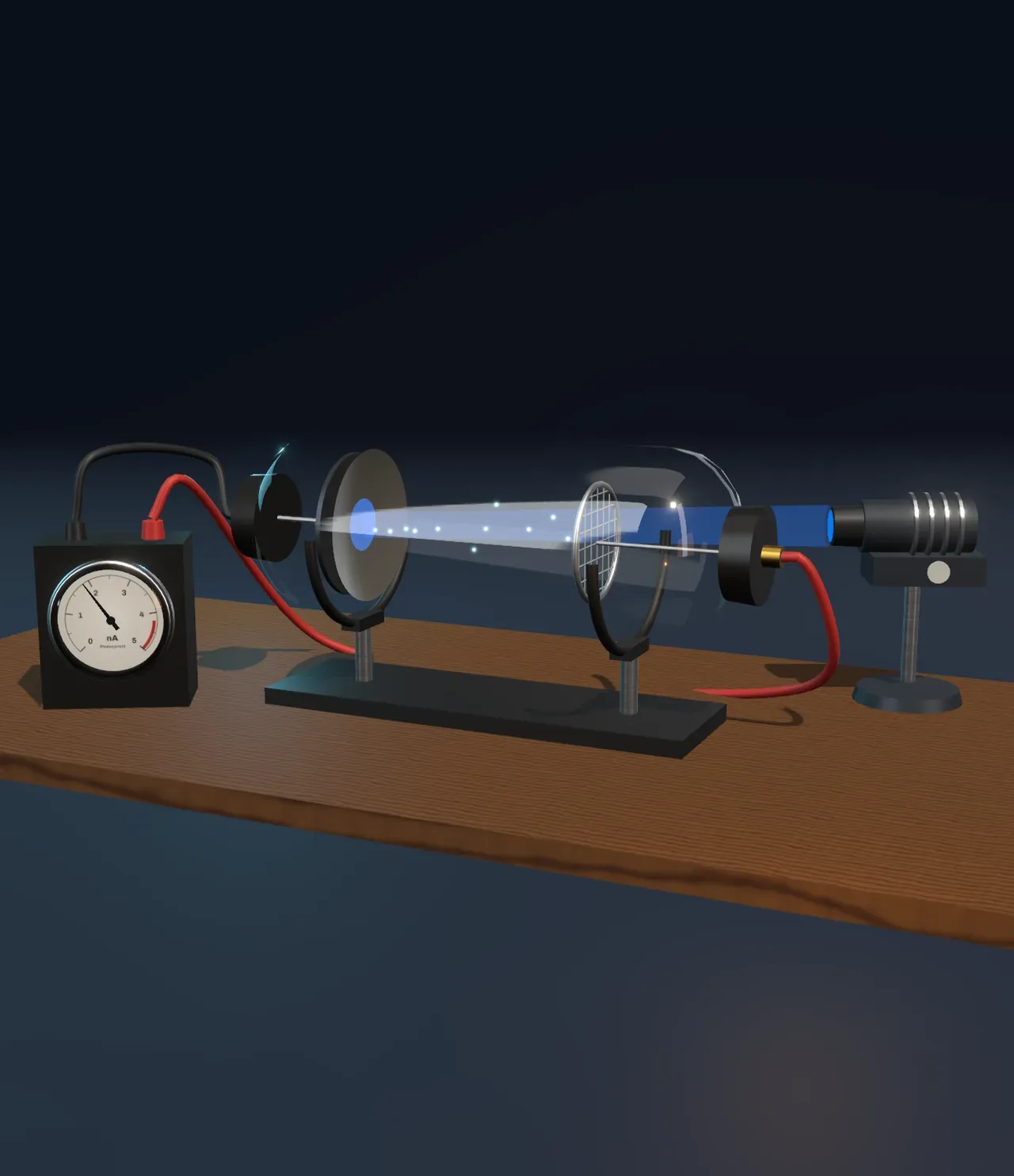
The Scene shows a photocell: a sodium plate in a tube emptied of air, a ring that collects the electrons that leave it, and a current meter. The plate is lit with Red light, and Light power is in the middle. Predict what will happen when the light is turned up to 100 µW.
Step 2 of 7
Light arrives as photons
In 1905 Einstein proposed that light arrives in packets of energy, photons. A photon’s energy depends only on the frequency:
Here is Planck’s constant, . These energies are very small, so they are measured in electronvolts: the energy an electron gains crossing a potential difference of one volt, 1 eV = 1.6 × 10⁻¹⁹ J.
Show the photons has shown the beam as photons. The light is now Blue, at 650 THz, that is hertz. Work out the energy of one photon and compare it with the readings beside the Scene: 2.69 eV.
Step 3 of 7
The threshold frequency
An electron in a metal is bound to it. Getting it out takes a minimum energy, the work function . A photon gives all its energy to one electron, all at once, and an electron cannot collect energy from several photons. So electrons leave only if . The threshold frequency is the frequency at which one photon pays exactly the work function:
Show the photons now shows one photon’s energy budget. Metal plate is locked on Calcium, whose work function is 2.9 eV.
Step 4 of 7
The stopping voltage
Above the threshold, the electron uses to get out and keeps the rest as kinetic energy. The fastest electrons are left with
To measure , a reverse voltage is connected that pushes the electrons back. The stopping voltage is the voltage that stops even the fastest, and the current falls to zero. A voltage of one volt takes one electronvolt from an electron, so : the stopping voltage in volts equals in electronvolts. Here it is Blue light on Sodium, W = 2.3 eV.
Step 5 of 7
Brightness
If light is photons, what does brighter light change? The light power is the energy arriving each second, so the number of photons each second is . Light frequency is locked. Predict what will happen when Light power is doubled.
Step 6 of 7
The electron’s speed
An electron’s kinetic energy is , with the electron’s mass, . To substitute, first convert from electronvolts to joules. The light is now ultraviolet, 1000 THz, on sodium.
Step 7 of 7
Measuring Planck’s constant
The graph of against is a straight line: . Its slope is , and it crosses the frequency axis at the threshold frequency. Change Metal plate: each metal moves the line along the axis, but the slope is the same for all of them. This is how Robert Millikan measured in 1916, and it was the sign that photons are real.
Loading the interactive version…
Loading the interactive version…
Each step sets up the Scene for you, and a control marked “fixed” stays put for that step.
Practice · Predict, then look
The red light, at 460 THz, frees no electrons from the sodium. What will happen when Light power is turned up to 100 µW?
Practice · Predict, then look
The red light, at 460 THz, frees no electrons from the sodium. What will happen when Light power is turned up to 100 µW?
Practice · Calculate
Calcium’s work function is 2.9 eV. What is its threshold frequency, in terahertz?
Practice · Calculate
Calcium’s work function is 2.9 eV. What is its threshold frequency, in terahertz?
Practice · Predict, then look
The plate is sodium, W = 2.3 eV. Predict the stopping voltage when the light is switched to Ultraviolet, at 1200 THz.
Practice · Predict, then look
The plate is sodium, W = 2.3 eV. Predict the stopping voltage when the light is switched to Ultraviolet, at 1200 THz.
Practice · Predict, then look
Blue light on sodium. What will happen to the energy of the fastest electron when Light power is doubled?
Practice · Predict, then look
Blue light on sodium. What will happen to the energy of the fastest electron when Light power is doubled?
Practice · Calculate
Ultraviolet light at 1000 THz on sodium. The energy of the fastest electron is in the readings beside the Scene. What is its speed?
Practice · Calculate
Ultraviolet light at 1000 THz on sodium. The energy of the fastest electron is in the readings beside the Scene. What is its speed?
Lesson complete. Every practice question here is done.