Light that knocks out electrons
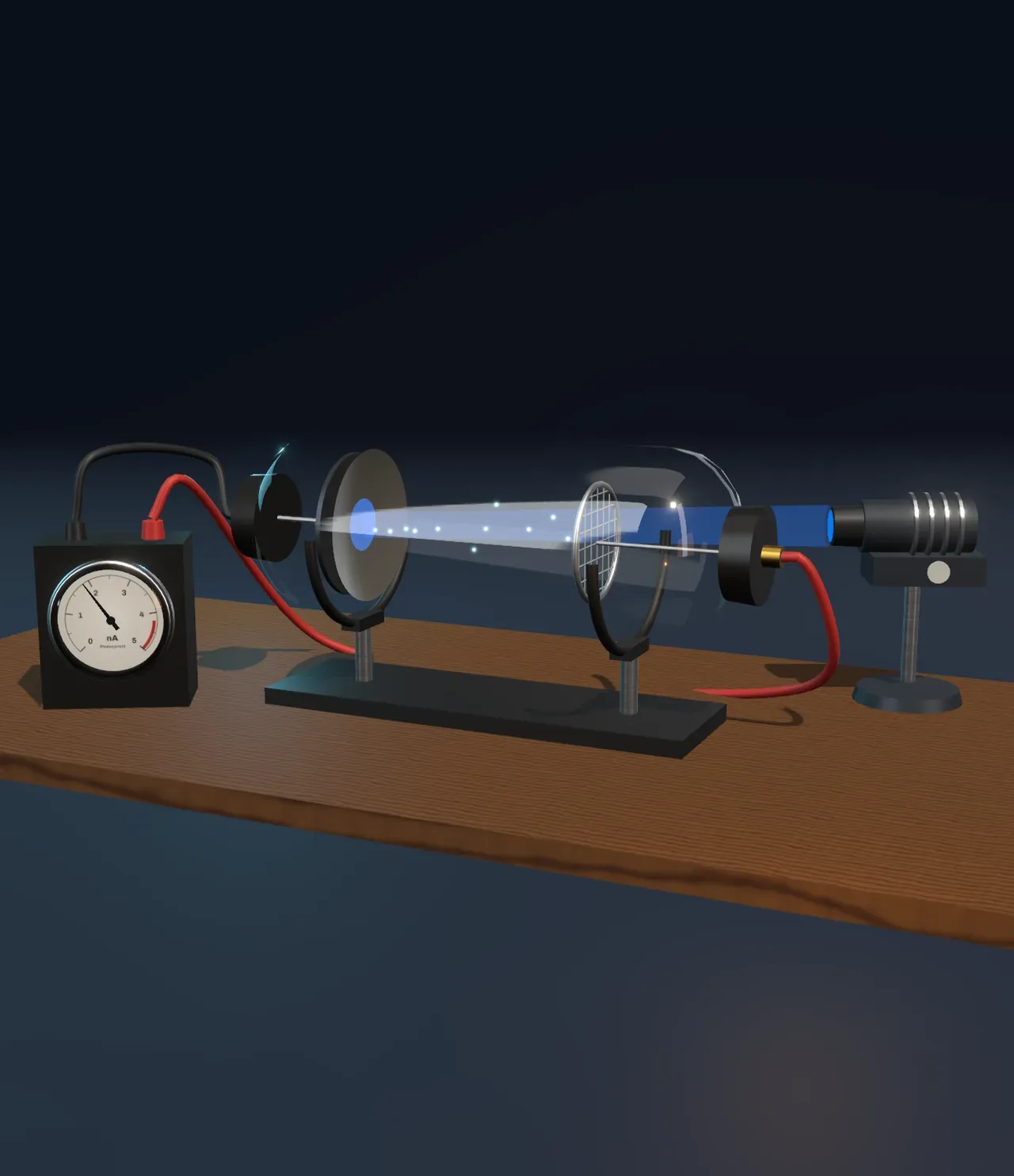
Shine light on a clean piece of metal in a vacuum and, with the right light, electrons fly out of its surface. This is the photoelectric effect. In the scene the metal is a shallow sodium dish at one end of a glass tube with the air pumped out. The electrons it releases cross the empty tube to a wire ring at the other end, and from there flow round the wires and through a sensitive meter back to the dish. The meter’s needle shows the photocurrent: about 1.9 nanoamperes, or twelve thousand million electrons a second, for the blue light the scene starts with.
Heinrich Hertz noticed the effect in 1887, when ultraviolet light helped sparks jump between two metal balls. By 1902 Philipp Lenard had measured it carefully in tubes like this one, and what he found made no sense for light as it was then understood.
The puzzle of the threshold
Light is a wave of electric and magnetic fields, and a brighter wave shakes a metal’s electrons harder. So brighter light ought to throw electrons out faster, and dim light of any colour, given enough time, ought to free some electrons eventually, once they had soaked up enough energy.
Neither happens. Each metal has a threshold frequency. Below it no electrons come out at all, however bright the light and however long you wait. Above it they come out at once, even in very dim light. Making the light brighter frees more electrons each second, but the fastest of them is no faster than before. Only raising the frequency makes them faster.
Try it: with the Sodium plate, choose Green under Light frequency and drag Light power to 100 µW. The plate is brightly lit and the meter reads zero. Now choose Blue and drop the power to 10 µW: electrons leave straight away.
Light comes in photons
In 1905 Albert Einstein explained the effect with an idea that most physicists at first refused to accept. Light, he proposed, arrives in separate packets of energy, later called photons. The energy of each photon depends only on the light’s frequency :
where is Planck’s constant, about 6.63 × 10⁻³⁴ joule-seconds. A photon of the scene’s blue light, at 650 terahertz (a wavelength of 461 nanometres), carries 2.69 electronvolts. An electronvolt is the energy one electron gains crossing one volt, 1.6 × 10⁻¹⁹ joules, the natural unit at this scale. Red light at 460 THz carries only 1.90 eV a photon; ultraviolet at 1200 THz carries 4.96 eV.
An electron in a metal is not free to leave. It is held in by the attraction of the metal’s positive ions, and it takes a minimum energy, the work function , to pull one out through the surface. For sodium that is about 2.3 eV, for calcium 2.9 eV, for zinc 4.3 eV.
The crucial step is that one photon gives all its energy to one electron, all at once. If is less than , no single photon can free an electron, and adding more photons does not help: the electron does not save up the energy of several. The light is simply absorbed and warms the metal. The threshold is the frequency at which one photon just pays the work function, : 556 THz for sodium, in the green, 701 THz for calcium, in the violet, and 1040 THz for zinc, in the ultraviolet.
Try it: slide Show the photons to the first stage. The beam becomes photons, short wave trains drawn at their own wavelength. With Green light on sodium each one lands with an orange glint and nothing more; switch to Blue and each one frees an electron where it lands.
How fast the electrons leave
Above the threshold the photon’s energy is more than enough. The electron uses to get out and keeps the rest as kinetic energy, the energy of its motion. For the electrons that leave most easily, from the very top of the metal’s electrons, that leaves
This is Einstein’s photoelectric equation. With blue light on sodium the fastest electron has 2.69 − 2.3 = 0.39 eV, enough to cross the tube at about 370 kilometres a second. Most leave with less, because they start deeper in the metal or lose some energy on the way out, so the scene shows a spread of speeds with a clear fastest.
The way to measure is to make the electrons climb. Connect a battery so the ring is negative and the electrons have to push against a voltage to reach it. As the voltage rises, the slower electrons are turned back first, and at the stopping voltage even the fastest one cannot make it and the current falls to zero. Since one volt takes one electronvolt from an electron, the stopping voltage in volts is in electronvolts: 0.39 V for blue light on sodium. The scene has no battery across the tube, but the readings beside it show the stopping voltage a battery would need.
Try it: open Show the photons halfway, to one photon’s energy budget. Step Light frequency from Blue up towards Ultraviolet: the photon’s arrow grows, the work function stays the same height, and all of the extra energy goes into the electron’s motion.
Brightness counts photons
What brighter light changes is the number of photons. Light of power at frequency delivers photons each second, about 116 million million for the scene’s 50 microwatts of blue light. A fixed share of those free an electron, so the current is proportional to the power: double it and the meter reading doubles, from 1.9 to 3.7 nA at 100 µW, while the fastest electron stays at 0.39 eV.
At the same power, light of higher frequency has fewer photons, because each carries more energy. That is why the meter reads less in ultraviolet at 50 µW (about 1.0 nA) than in blue, even though the electrons are far faster.
Try it: in blue light, move Light power from 10 µW to 100 µW. The flow of electrons thickens and the needle swings up, but the fastest electron in the readings beside the Scene stays at 0.39 eV.
Measuring Planck’s constant
If , then a graph of the fastest electron’s energy against frequency is a straight line that crosses the frequency axis at the threshold and rises with slope . A different metal moves the line along, since its is different, but cannot change the slope. Robert Millikan, who expected to prove Einstein wrong, spent years cleaning metal surfaces in a vacuum to test exactly this, and by 1916 he had confirmed the straight line and measured from its slope, in agreement with the value Max Planck had found from the colours of hot objects.
Try it: slide Show the photons all the way to Photons and energy and change Metal plate. Each metal’s line starts at its own threshold, and all three run parallel.
Einstein’s Nobel Prize, in 1921, was awarded for this explanation, not for relativity. Light is not simply a stream of particles, though: it still spreads, bends and interferes as a wave. Photons are how light gives up its energy, one packet at a time, and the wave–particle duality Article shows electrons behaving with the same double nature.
Where it is used
Photocells like the one in the scene once counted people through doors, read the soundtracks printed beside the pictures on cinema film, and measured light for photographers. A photomultiplier adds a chain of electrodes after the cathode, each knocking out several electrons for every one that hits it, so a single photon becomes a pulse of millions of electrons. Photomultipliers detect the faint flashes in medical scanners and the neutrino detectors buried under mountains.
In solar cells and camera sensors a photon frees an electron inside a semiconductor rather than out of a metal. The rule is the same: one photon, one electron, and only if the photon brings enough energy, which is why each kind of sensor is blind beyond some wavelength.
What this model leaves out
The scene works out the photon energy, the fastest electron and the current from the equations above, with textbook work functions for perfectly clean metal. Real surfaces vary by a few tenths of an electronvolt with the crystal face and with any film of oxide or gas, and sodium and calcium tarnish in seconds in air, which is why real photocathodes are sealed in a vacuum.
The share of photons that free an electron is held fixed at one in 10,000. Real metals free between about one in a thousand and one in a hundred thousand, and the share starts at zero at the threshold and grows as the frequency rises above it, so a real current would creep up from nothing rather than jump. A few electrons can also escape slightly below the threshold, helped by the metal’s heat.
Every electron that leaves is assumed to reach the ring, though with no voltage across a real tube some would miss it or be turned back by the charge of the others. The electrons travel in straight lines, far slower than in reality, and the photons are drawn as short wave trains so that their wavelength can be seen; a real photon has no fixed size or shape.