Hooke's law, where the mass comes to rest, and what sets the period of a bounce on a spring, and what does not.
Step 1 of 5 · Hooke's law
Step 1 of 5
Hooke’s law
A stretched spring pulls back, and the more you stretch it, the harder it pulls. For most springs, as long as you do not overstretch them, the force is in proportion to the stretch:
This is Hooke’s law. is how far the spring is stretched from its natural length, and is the spring stiffness, also called the spring constant, in newtons per metre: how many newtons the spring pulls with for every metre of stretch. The minus sign says the force always points back, against the stretch.
When you hang a mass on the spring, it stretches until its upward force balances the mass’s weight: . That place is the equilibrium position. The mass can rest there, and it is the middle of every bounce that follows.
Spring stiffness and Mass are now fixed. Work out how far the mass stretches the spring when it hangs at rest.
Step 2 of 5
A bigger pull
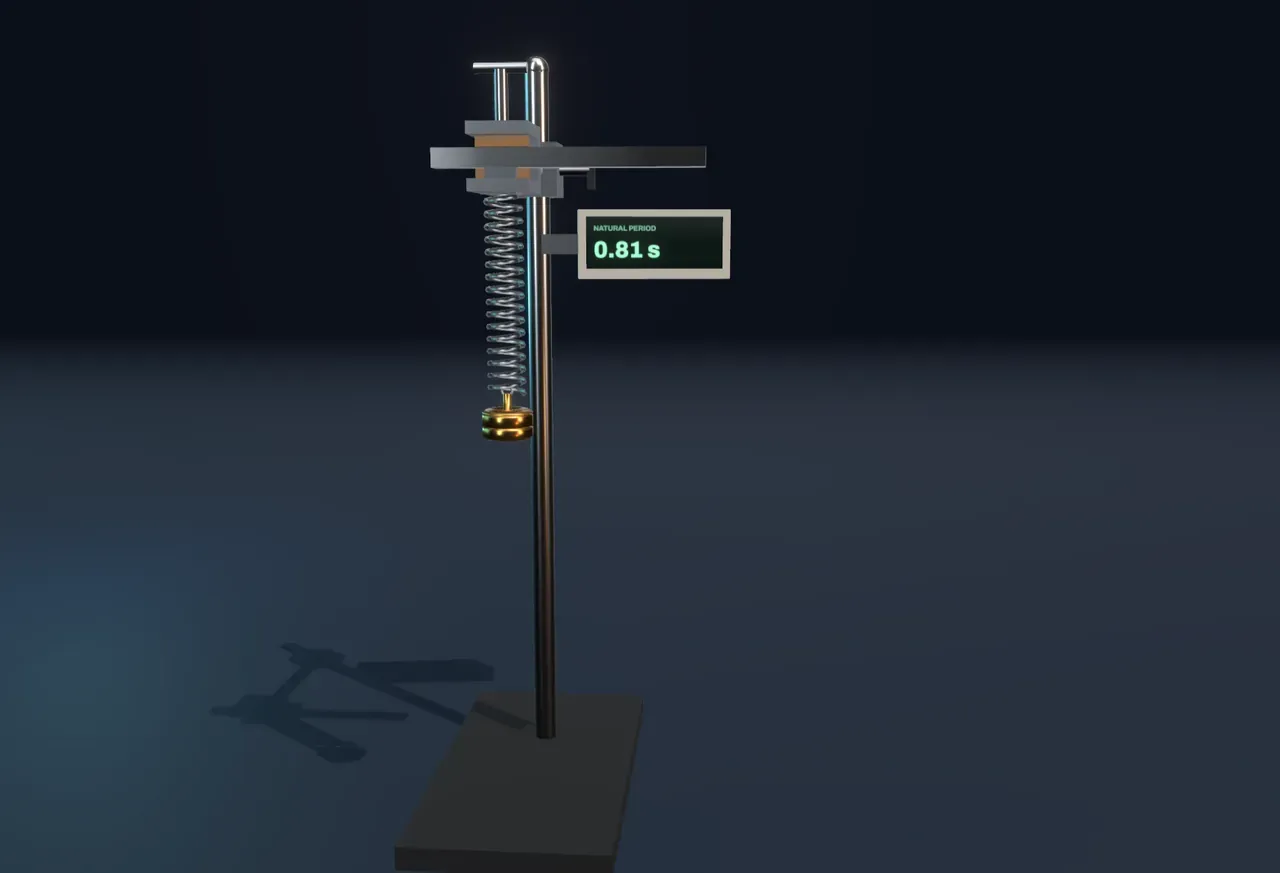
Pull the mass below the equilibrium position and let go, and it bounces up and down about that point. The time for one whole oscillation, down, up and back again, is the period , and the Scene’s timer shows it. The greatest distance from the equilibrium position, here Pull down, is the amplitude .
The pull is now 0.05 m. Predict what will happen to the period when you pull four times as far, then watch the timer.
Step 3 of 5
The period formula
So what does change the period? A stiffer spring pulls harder, so it turns the motion round sooner. A bigger mass is harder to speed up and slow down, so it takes longer. Together:
The amplitude is not in the formula, as the timer showed. The timer is now hidden: work out the period yourself.
Step 4 of 5
Four times the mass
The square root in the formula says the period changes more slowly than the mass. Before you move Mass, answer: what will happen to the period when the 0.2 kg mass is replaced by a 0.8 kg one? Then check on the timer.
Step 5 of 5
One bounce a second
Now everything is free. Build an oscillator with a period of one second: first work out what ratio it needs, then choose Spring stiffness and Mass and read the timer.
Loading the interactive version…
Loading the interactive version…
Each step sets up the Scene for you, and a control marked “fixed” stays put for that step.
Practice · Calculate
A 0.5 kg mass hangs at rest on a spring of stiffness 30 N/m. How far does it stretch the spring? Use .
Practice · Calculate
A 0.5 kg mass hangs at rest on a spring of stiffness 30 N/m. How far does it stretch the spring? Use .
Practice · Predict, then look
The mass will be pulled four times as far, from 0.05 m to 0.20 m, on the same spring with the same mass. What will happen to the period?
Practice · Predict, then look
The mass will be pulled four times as far, from 0.05 m to 0.20 m, on the same spring with the same mass. What will happen to the period?
Practice · Calculate
A 0.8 kg mass hangs on a spring of stiffness 20 N/m. What is the period of its bounce?
Practice · Calculate
A 0.8 kg mass hangs on a spring of stiffness 20 N/m. What is the period of its bounce?
Practice · Choose
On the same 30 N/m spring, a 0.2 kg mass is replaced by a 0.8 kg one. What happens to the period?
Practice · Choose
On the same 30 N/m spring, a 0.2 kg mass is replaced by a 0.8 kg one. What happens to the period?
Practice · Reach the target
Change Spring stiffness and Mass until the period is 1.00 s, then press Check.
Practice · Reach the target
Change Spring stiffness and Mass until the period is 1.00 s, then press Check.
Lesson complete. Every practice question here is done.