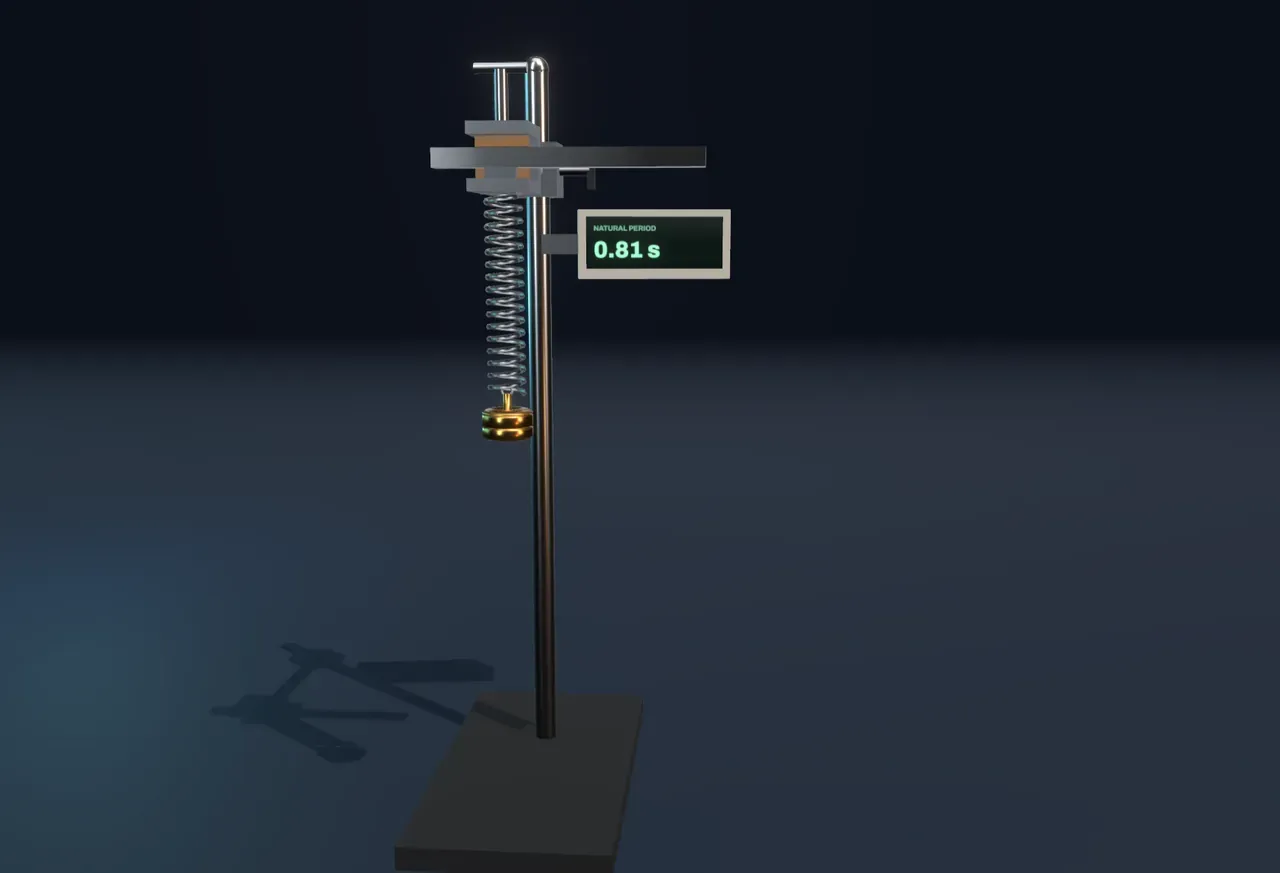
A bounce that keeps time
Hang a weight on a spring, pull it down a little and let go. It bounces up and down, and if you time the bounces they come at a remarkably steady beat. Pull it down further and the bounces get bigger, but they do not get slower: each one still takes the same time. That steadiness is why springs sit inside wind-up watches, and why a car on its springs rocks at its own particular rate after a bump.
The motion has a name, simple harmonic motion, and it turns up far beyond springs.
The further you stretch it, the harder it pulls
A spring pulls back when you stretch it, and the more you stretch it, the harder it pulls. For most springs, stretched within reason, the pull is simply proportional to the stretch:
This is Hooke’s law. Here is how far the spring is stretched or squashed from its natural length, and is the spring stiffness in newtons per metre: how hard the spring pulls for each metre of stretch. The minus sign says the pull is always back towards where the spring started.
When you hang a weight on the spring, it stretches until the spring’s pull up balances gravity’s pull down, at a stretch of . That resting place is the equilibrium, and it is the middle of every bounce that follows. A heavy mass on a soft spring hangs noticeably lower than a light mass on a stiff one.
Why the beat does not depend on the bounce
Pull the mass below its resting place and let go. The spring pulls it back up, harder the further it is from the middle, so it speeds up all the way to the middle, overshoots, and slows down as the spring squashes, until it stops and comes back. Measured from the equilibrium, gravity’s steady pull has already been balanced, so what is left is a force proportional to the distance from the middle and pointing back towards it. That is the definition of simple harmonic motion.
The proportion is what makes the timing steady. Pull the mass twice as far and the spring pulls twice as hard, so the mass reaches twice the speed and has twice as far to go. The two effects cancel exactly, and the trip takes the same time.
Try it: watch the timer and slide Pull down between 0.05 m and 0.2 m. The bounce grows, but the period does not change at all.
Stiffness and mass set the rhythm
What does change the period is the spring and the mass. A stiffer spring pulls harder for the same stretch, so it turns the mass round sooner. A heavier mass is harder to speed up and slow down, so it takes longer. Put together, the time for one full bounce is
The square root means the period changes more gently than the mass or the stiffness do. With the scene’s 30 N/m spring, a 0.2 kg mass bounces once every 0.51 s and a 0.8 kg mass once every 1.03 s: four times the mass, twice the period. Going from a 20 N/m spring to an 80 N/m one with the same mass halves the period in the same way.
The circle hidden in the bounce
Choose On under Show circle and energy. To the right of the mass, a paper chart runs away from a pen that follows the mass up and down, and the bounce unrolls into a smooth wave. It is a sine wave, the same curve you get from the height of a point going steadily round a circle.
To the left, a point does exactly that. It goes round the circle once in each period, and it is always at the same height as the mass, joined to it by a level line. Its distance across from the centre is the mass’s speed, scaled by the rate it goes round, which is why the mass is fastest as it passes the middle, where the point is at the side of the circle, and stops for an instant at the top and bottom. So simple harmonic motion is steady motion round a circle, seen edge on. The same picture is behind the unit circle and circular motion.
Energy trading back and forth
The glass column beside the stand splits the energy in two. The orange part is the mass’s kinetic energy, its energy of motion; the blue part is potential energy stored in the stretched or squashed spring. At the bottom and top of each bounce the mass is still for a moment and everything is potential energy. As it passes the middle, everything is kinetic. In between the energy pours from one to the other twice in every period, and the total stays the same, because nothing in the scene takes any away. Kinetic and potential energy follows the same trade in a falling ball and a roller coaster.
Strictly, a hanging mass also stores and releases gravitational energy as it rises and falls. Measured from the resting place, gravity’s share and the spring’s combine into a single stored energy, , where is now the distance from the equilibrium; that combined amount is what the blue part shows.
Springs everywhere
Simple harmonic motion appears whenever something is pushed back towards a resting place in proportion to how far it has gone. A pendulum swinging through small angles, a ruler twanged on the edge of a desk, a guitar string, the air in an organ pipe, the balance wheel of a mechanical watch and the atoms in a solid, each held in place by its neighbours as if by springs, all move this way to a good approximation. Each has its own natural period, and pushing it in step with that period is what makes resonance so powerful.
What this model leaves out
The spring here is weightless and perfectly elastic, with no friction or air resistance, so the bounce goes on for ever. A real spring loses a little energy on every bounce, mostly to heat inside the metal and to the air, so its bounce slowly dies away, although the period barely changes as it does. A real spring also has mass of its own, which slows the bounce slightly: a common correction adds about a third of the spring’s mass to the hanging mass. Hooke’s law holds only up to the spring’s elastic limit; stretch a spring too far and it stays bent out of shape, and squash it too far and its coils touch. The scene keeps to pulls small enough for neither to happen, and the mass moves only up and down, without the sideways swing a real spring can pick up.