The circle hiding behind the bounce: frequency and angular frequency, the top speed, where the acceleration is largest, and the energy passing back and forth.
Step 1 of 6 · The circle behind the bounce
Step 1 of 6
The circle behind the bounce
Measured from the equilibrium position, gravity is already balanced, and the net force on the mass is : in proportion to the distance from the middle and always pointing back towards it. An oscillation driven by a force like that is called simple harmonic motion, and it has a beautiful picture: a point going round a circle at a steady speed. Look at the circle exactly side on and you see only the point’s height, which rises and falls just like the mass.
Before you see the circle, predict: where on its path does the mass move fastest? Once you answer, Show circle and energy will move to On.
Step 2 of 6
Frequency
The point goes round the circle once every period, and the circle’s radius is the amplitude . If you measure time from the release, and position downwards from the equilibrium position, the mass is at
That is the cosine from the unit circle, on a circle of radius . is the angular frequency: how many radians the point turns through each second. A full turn is radians in a time , so , and for a spring . The frequency counts whole turns, that is oscillations, per second: , in hertz, .
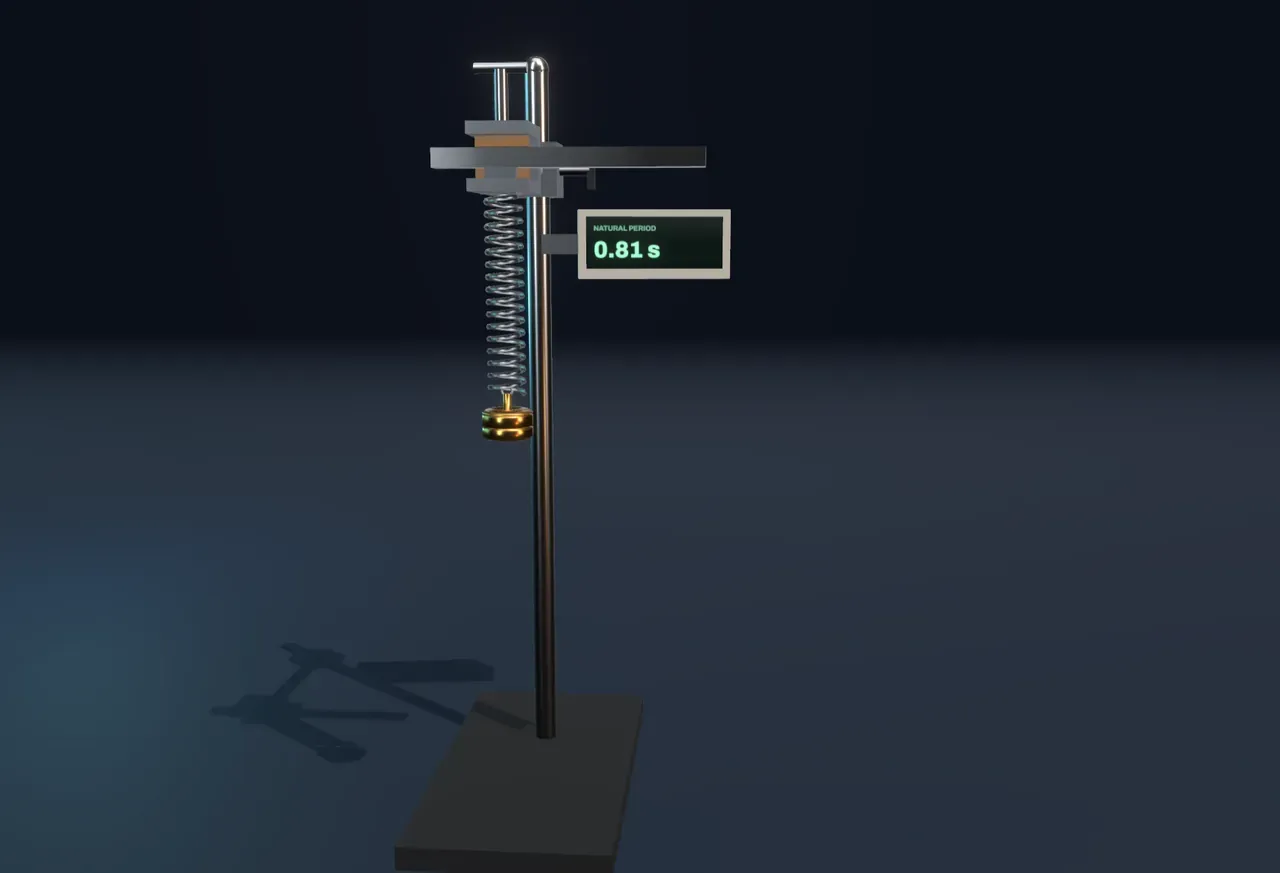
Work out the frequency of the mass. The timer shows the period.
Step 3 of 6
The top speed
The point on the circle moves at a steady speed: every period it covers a whole circumference, , so its speed is . When the mass passes the middle, the point is at the side of the circle, moving straight up or down along with the mass. So the top speed of the mass is
Pull down, Spring stiffness and Mass are now fixed. Work out .
Step 4 of 6
The acceleration
By Newton’s second law, the acceleration of the mass is the net force divided by the mass:
The acceleration always points towards the middle, and its size is in proportion to the distance from it. Using the formula, answer where the acceleration is largest. Then watch the mass: where does it turn round sharply, and where does it sweep past without changing speed?
Step 5 of 6
The energy
The glass column beside the stand splits the energy of the bounce in two: orange for the kinetic energy, , and blue for the stored energy, , with measured from the equilibrium position. The blue part also includes the change in the mass’s gravitational energy, so gravity does not appear separately.
At the turning points the mass stands still for an instant, and all of the energy is stored: . In the middle all of it is kinetic: . Without friction the total stays the same and only changes form, twice every period.
Work out the total energy of the bounce.
Step 6 of 6
Twice the pull
To sum up: the amplitude does not change the period, but it appears in the top speed, , in the acceleration at the ends, , and in the energy, . Answer which of these double when you double the pull, then check in the Scene: move Pull down from 0.06 m to 0.12 m, and watch the timer and the circle.
Loading the interactive version…
Loading the interactive version…
Each step sets up the Scene for you, and a control marked “fixed” stays put for that step.
Practice · Predict, then look
The mass bounces up and down about the equilibrium position. Where on its path does it move fastest?
Practice · Predict, then look
The mass bounces up and down about the equilibrium position. Where on its path does it move fastest?
Practice · Calculate
A 0.5 kg mass bounces on a spring of stiffness 30 N/m. What is the frequency of the bounce, in hertz?
Practice · Calculate
A 0.5 kg mass bounces on a spring of stiffness 30 N/m. What is the frequency of the bounce, in hertz?
Practice · Calculate
The mass, 0.5 kg on a 30 N/m spring, was pulled 0.12 m from the equilibrium position and let go. What is its top speed?
Practice · Calculate
The mass, 0.5 kg on a 30 N/m spring, was pulled 0.12 m from the equilibrium position and let go. What is its top speed?
Practice · Choose
Where is the acceleration of the mass largest?
Practice · Choose
Where is the acceleration of the mass largest?
Practice · Calculate
The mass on the 30 N/m spring was pulled 0.12 m from the equilibrium position and let go. What is the total energy of the bounce?
Practice · Calculate
The mass on the 30 N/m spring was pulled 0.12 m from the equilibrium position and let go. What is the total energy of the bounce?
Practice · Choose
The pull is doubled, from 0.06 m to 0.12 m, on the same spring with the same mass. Which of these grow exactly times? Select all that apply.
Practice · Choose
The pull is doubled, from 0.06 m to 0.12 m, on the same spring with the same mass. Which of these grow exactly times? Select all that apply.
Lesson complete. Every practice question here is done.