The Sun evaporates water from the sea, the wind carries it inland, and a mountain lifts the air until it cools to its dew point. Work out the cloud base from the cooling rate, find the freezing level, and see why there is desert behind mountains.
Step 1 of 6 · The Sun lifts water
Step 1 of 6
The Sun lifts water
Almost all the Earth’s water, about , is in the oceans. The water does not stay put: it evaporates from the sea, travels in the air, falls as rain or snow and returns to the sea. That is the water cycle, and it makes no new water and loses none: the same water has been going round it for billions of years.
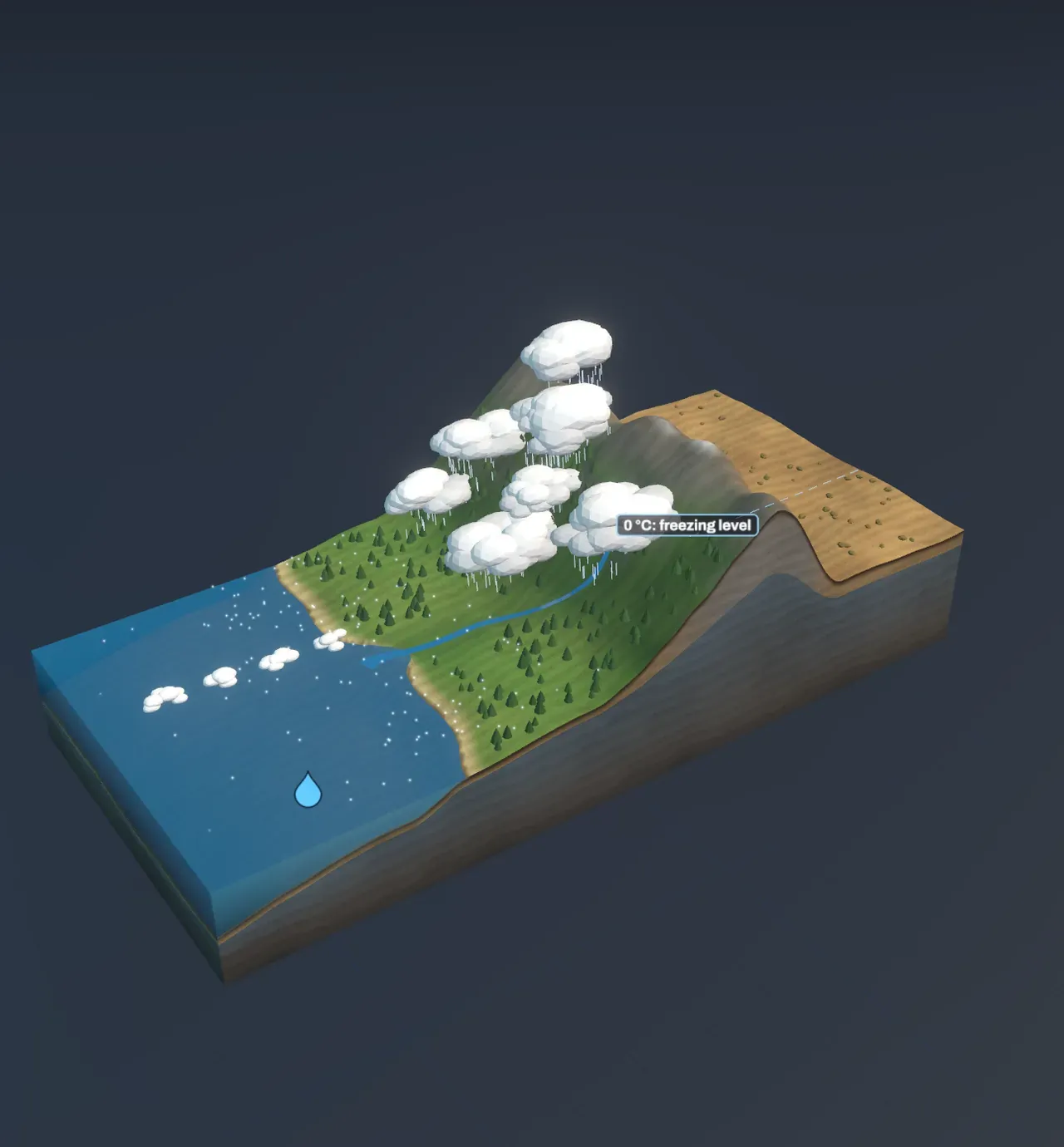
In the Scene there is a cross-section of country from the sea to a mountain range. With Follow the water you follow one droplet, and it is now at Evaporation: a molecule that broke free of the sea’s surface and rides the wind as vapour, a clear gas you cannot see.
Step 2 of 6
A warmer sea
At the water’s surface there are always molecules moving faster than average, and one that is fast enough escapes into the air. So water evaporates at every temperature, not only when it boils. The only question is how much. Sea temperature is now low, like a northern sea in winter.
Step 3 of 6
The cloud base
The wind pushes the damp air up the mountain. As it rises the pressure around it drops, it expands and cools: almost 10 °C every kilometre. Cold air can hold less vapour, and at some height it reaches its dew point, the temperature at which it is saturated. Above that the vapour condenses into tiny droplets, and they are the cloud. That height is the cloud base, which is why many clouds have flat bottoms.
A cloud is not vapour: it is droplets. The vapour itself is clear. Sea temperature is locked at 15 °C.
Step 4 of 6
Rain or snow
Inside the cloud the droplets collide and merge until they are heavy enough to fall: precipitation. The air keeps cooling as it climbs, and at some height it reaches 0 °C: the freezing level, the line marked on the slope. Below it rain falls, and above it snow. Height of the mountains is locked.
Step 5 of 6
Higher mountains
Sea temperature is back at 15 °C, and the mountains are now low hills. How much rain falls depends on how much the air cools, and that depends on how high it is forced to climb.
Step 6 of 6
Back to the sea
The droplet has reached Runoff: the rainwater runs downhill into the river, and the river carries it back to the sea. Some of the water soaks into the ground and becomes groundwater, the subject of the next Lesson. Behind the range, on the far side, the land is yellow and dry.
Loading the interactive version…
Loading the interactive version…
Each step sets up the Scene for you, and a control marked “fixed” stays put for that step.
Practice · Choose
Every day about 1000 km³ of water evaporates from the oceans. Where does the energy come from that turns all that water into vapour?
Practice · Choose
Every day about 1000 km³ of water evaporates from the oceans. Where does the energy come from that turns all that water into vapour?
Practice · Predict, then look
Sea temperature is now 4 °C, a cold sea. Predict: what will happen to evaporation if the sea warms to 28 °C, a tropical sea?
Practice · Predict, then look
Sea temperature is now 4 °C, a cold sea. Predict: what will happen to evaporation if the sea warms to 28 °C, a tropical sea?
Practice · Calculate
Sea temperature is locked at 15 °C. The air over the sea is 80% saturated with vapour, so its dew point is about 11.6 °C. Rising, the air cools by 9.8 °C every kilometre, and its dew point falls by 1.8 °C every kilometre. At what height does the air reach its dew point: how high is the cloud base?
Practice · Reach the target
Height of the mountains is locked at 2500 m, and the droplet we are following comes down on the slope as rain. Change Sea temperature until it lands as snow, and press Check.
Practice · Reach the target
Height of the mountains is locked at 2500 m, and the droplet we are following comes down on the slope as rain. Change Sea temperature until it lands as snow, and press Check.
Practice · Predict, then look
The mountains are now 800 m hills. Predict: what will happen to the rain on the windward slope if Height of the mountains rises to 4200 m?
Practice · Predict, then look
The mountains are now 800 m hills. Predict: what will happen to the rain on the windward slope if Height of the mountains rises to 4200 m?
Practice · Choose
On the far side of the mountains, in the rain shadow, almost no rain falls, though the very same wind passes over it. Why?
Practice · Choose
On the far side of the mountains, in the rain shadow, almost no rain falls, though the very same wind passes over it. Why?
Lesson complete. Every practice question here is done.