A star in a jar
To fuse deuterium and tritium, a plasma has to reach about 150 million kelvin, ten times the temperature at the centre of the Sun. Nuclear fusion explains why it must be that hot. This Article is about the harder part: keeping it there.
Nothing solid survives contact with a plasma that hot, and the plasma would cool in an instant if it touched a wall. But a plasma is made of charged particles, bare nuclei and free electrons, and charged particles in a magnetic field cannot cross it. They circle round the field lines and slide along them, as beads slide along a wire. So a reactor builds a cage out of field lines.
A straight cage leaks out of its ends. Bend it round into a ring and the field lines close on themselves, so a particle sliding along one never comes to an end. That ring is the doughnut-shaped vessel of a tokamak, a design from the Soviet Union in the 1950s whose name is a Russian abbreviation for a ring-shaped chamber with magnetic coils.
Why a plain ring leaks
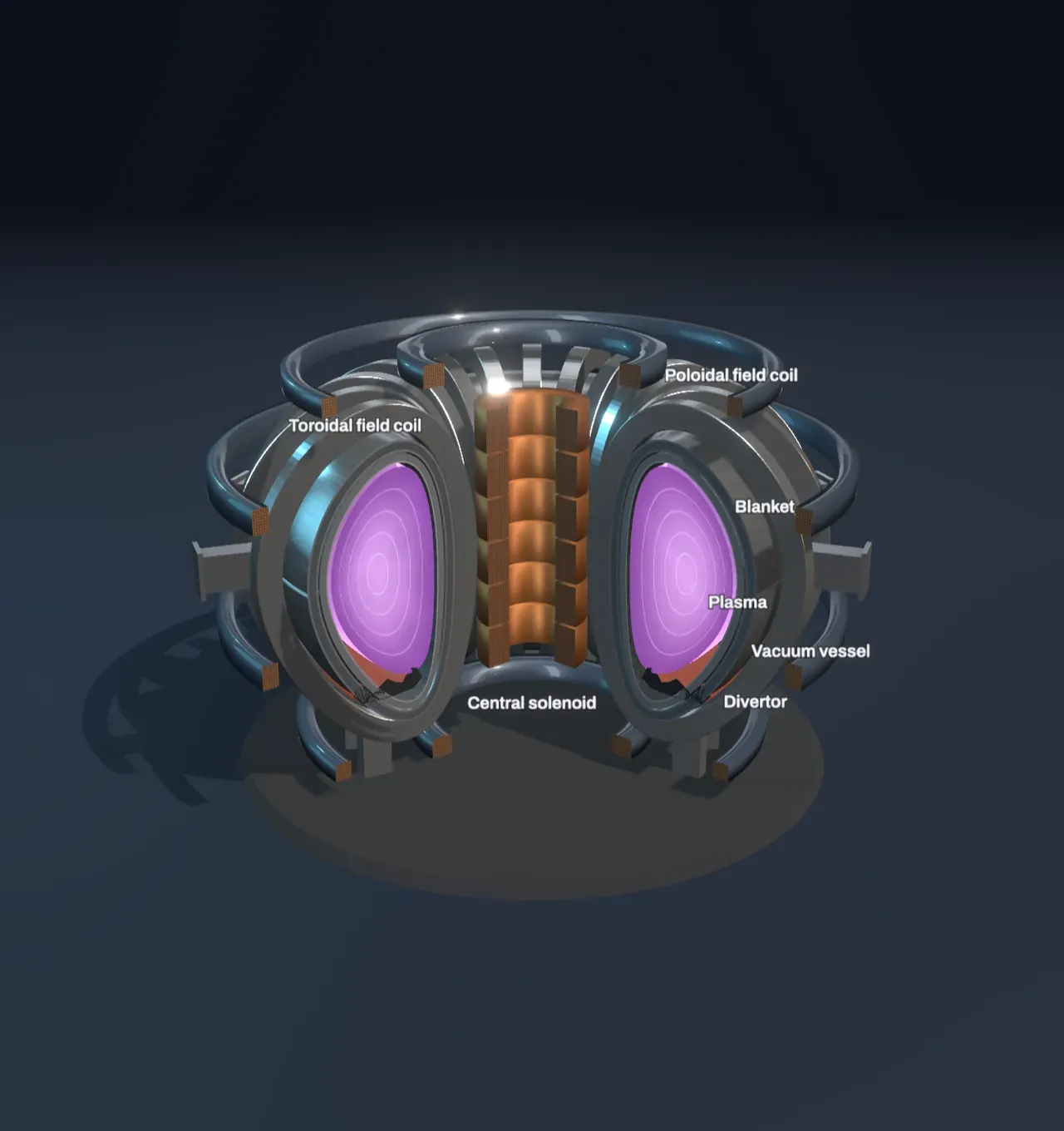
In the scene, eighteen D-shaped toroidal field coils stand round the vessel and make a field that runs the long way round the ring. On its own, that field fails.
Bending the field into a ring crowds the coils together on the inside of the ring, so the field there is stronger than on the outside. A particle’s circle is a little tighter where the field is stronger, so each circle does not quite close: the particle creeps sideways, up or down, a little on every turn. Positive ions creep one way and electrons the other. The charges separate, the separated charge makes an electric field, and that field shoves the whole plasma outwards into the wall. In a machine the size of ITER, a hot ion would drift from the middle to the wall in a few thousandths of a second.
Try it: slide Plasma current down to 0 MA, then choose On under Show field and particles. The field lines become plain circles, ions (orange) drift up and electrons (blue) drift down until they hit the wall.
The twist
The cure is to twist the field lines into spirals. A tokamak does it by driving a current of millions of amperes through the plasma itself, the long way round the ring. The central solenoid in the middle of the doughnut drives it, the way the first coil of a transformer drives the second. That current makes its own field, which wraps round the plasma the short way. Added to the field from the coils, it turns every field line into a spiral that winds round the ring and over and under the plasma at the same time.
Now a particle following its field line spends half its time near the top of the plasma and half near the bottom. It still drifts upwards all the time, but at the top that carries it outwards from the middle of the plasma, and at the bottom it carries it back in. The drifts cancel, and the particle stays on a closed loop instead of reaching the wall.
The twist is measured by the safety factor, : how many times a field line goes round the long way for each time it goes round the short way. It is largest at the plasma’s edge. ITER is designed for 15 million amperes in a 5.3 tesla field, which gives an edge of about 3.
Try it: raise Plasma current slowly from zero, with Show field and particles on On. The field lines start to spiral, the particles’ paths swing round the middle of the plasma, and near 7 MA they stop reaching the wall.
A stellarator gets its twist another way, from coils bent into strange three-dimensional shapes, so it needs no current in the plasma. Germany’s Wendelstein 7-X is the largest.
Not too much twist
More current is not always better. If a field line winds round the short way more than once for every two times round the long way, below 2, the plasma column buckles into a spiral of its own, a kink, that grows until it hits the wall. All the heat is dumped in about a thousandth of a second, a disruption, and the sudden current in the steel can shake the whole machine.
The twist depends on the current and the field together: rises with the field and falls with the current. So a machine with a weaker field must carry less current.
Try it: choose JET’s field with Plasma current at 15 MA. The twist is too tight and the plasma kinks and disrupts, again and again. Lower the current to 12 MA and it holds.
Hot, dense and held long enough
Holding the plasma is not enough. It has to make more fusion power than it loses. In 1955 the engineer John Lawson worked out what that takes, and it comes down to three numbers multiplied together: the density , the number of fuel nuclei in each cubic metre; the temperature ; and the energy confinement time , how long the plasma would take to lose its heat if the heating were switched off.
The fusion is self-sustaining, ignition, when the helium nuclei it makes heat the plasma as fast as it loses heat. For deuterium and tritium that needs about
at best, near 150 million kelvin, with in kiloelectronvolts (1 keV is about 11.6 million kelvin). Short of ignition, the plasma can still give a gain, : fusion power divided by the heating power put in. is breakeven.
The chart beside the scene is this Lawson diagram. The dot is the scene’s plasma. ITER’s settings put it about two thirds of the way to ignition, at a gain of about 10: ITER is meant to make 500 megawatts of fusion from 50 megawatts of heating.
Try it: drag Plasma temperature from 10 to 300 million K. The dot slides sideways but hardly moves up or down, and the gain rises, peaks near 150 million K and falls again.
The field can only hold so much pressure, so at a given field a hotter plasma is a thinner one. Too cool, and too few nuclei fuse however dense the plasma is. Too hot, and there are too few nuclei to meet. The best temperature lies in between.
Why stronger magnets help so much
A magnetic field holds back a plasma whose pressure is a few per cent of the field’s own magnetic pressure, and magnetic pressure grows with the square of the field. Twice the field holds four times the pressure, and with four times the pressure four times the fuel can be packed in at the same temperature.
ITER’s coils are superconductors, niobium–tin cooled to about 4 kelvin, so they carry huge currents with no resistance (Superconductivity). Newer tape made of high-temperature superconductors works at about 20 kelvin and in stronger fields, so a much smaller machine can reach the same triple product. SPARC, being built in the United States, is designed for 12.2 tesla. The same kind of magnet bends the beams in particle accelerators.
Try it: choose SPARC’s field. In a machine this size the plasma would ignite. Then choose JET’s field and lower Plasma current to 12 MA: the plasma holds again, but its gain falls to about 2.
The rest of the machine
The fusion energy comes out mostly as neutrons, which have no charge, so the field cannot hold them. They fly into the blanket, the thick tiled lining of the vessel, and heat it; in a power station that heat would raise steam. A blanket would also contain lithium, which neutrons turn into fresh tritium, because tritium is too rare to buy. The divertor at the bottom is where the field lines at the plasma’s edge are steered into tough tungsten plates, so the helium ash and stray heat land there and not on the wall. Everything sits inside the vacuum vessel, and the poloidal field coils round the outside shape the plasma and hold it in place.
Nobody has yet made electricity from fusion. In 2023 Europe’s JET tokamak released 69 megajoules in about five seconds, a record, but still less than it took to heat the plasma. In 2022 the National Ignition Facility in California got more fusion energy out of a tiny fuel pellet than its lasers delivered to it, holding the fuel together not with a field but by its own inertia, for well under a billionth of a second. The Sun needs neither: its gravity holds its plasma.
What this model leaves out
The scene works out the twist, the pressure the field can hold, the confinement time and the gain from simple rules matched to ITER, for one plasma temperature everywhere. A real plasma is hottest at its centre, and its density is also limited by the current. The confinement time follows the measured way it grows with current and field, but the measured fall as more heating is put in is left out, and so are impurities that cool the plasma. The 1.9% pressure share is chosen so that ITER’s settings give ITER’s design gain.
The particles’ drifts are exaggerated hundreds of times, so in the scene it takes about half of ITER’s current to hold them, where a real plasma needs far less twist than that to stop single particles drifting out. The ions’ circles are drawn dozens of times too large, and the electrons’ circles, sixty times smaller still, are not drawn at all. A real ion goes round the ring in about 40 millionths of a second, not a few seconds. The kink is drawn as a regular wobble that grows and strikes the wall every four seconds; a real disruption is a single violent event that ends the pulse.