A number and a unit
Every measurement has two parts, a number and a unit. “The box is 10 cm wide” means that a centimetre fits along its edge ten times. The unit is the thing you count with, and the number is how many of it fit. Change the unit and the number changes, while the box stays exactly the same.
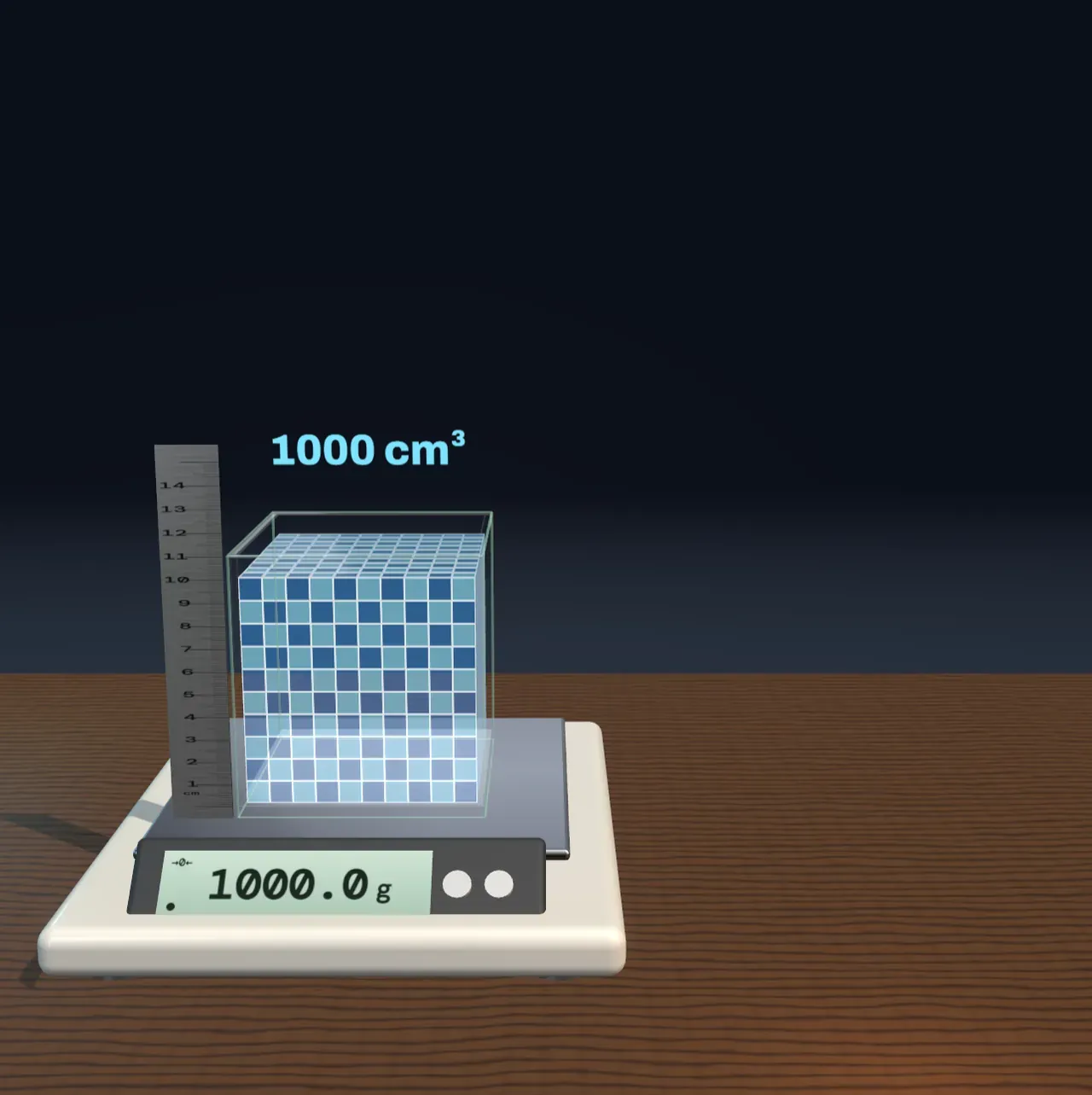
The Scene has one thing to measure: a glass box 10 cm across on the inside, filled to the brim with a litre of water, standing on a balance. With Centimetre chosen and Measure set to Volume, the water is marked out into centimetre cubes and the label above it counts them: 1000 cm³. Choose Millimetre and the same water holds a million cubic millimetres. Choose Decimetre and it is a single cubic decimetre, which is what a litre is.
Try it: keep Volume and step Unit from Millimetre to Metre. The count goes 1 000 000, 1000, 61.02, 1, 0.03531, 0.001. Nothing on the balance moves.
Lengths, areas and volumes
Set Measure to Length and the count is how many units fit along one edge: 100 mm, 10 cm, 1 dm. Area counts unit squares on one face: 10 000 mm², 100 cm², 1 dm². Volume counts unit cubes in the whole box.
A centimetre is ten millimetres, but a square centimetre is a hundred square millimetres, ten rows of ten, and a cubic centimetre is a thousand cubic millimetres. Each time the unit shrinks ten times, a length count grows ten times, an area count a hundred times and a volume count a thousand times. That is why a cubic metre is not a hundred but a million cubic centimetres, and why it holds a thousand litres. The same arithmetic, run the other way, is why a creature twice as tall weighs eight times as much, the subject of scaling and the square–cube law.
Prefixes and powers of ten
The metric units go up and down in powers of ten, and a prefix says which power: milli is a thousandth, centi a hundredth, deci a tenth, kilo a thousand, mega a million. A millimetre is a thousandth of a metre and a kilogram a thousand grams. The same prefixes work on any unit, so a kilowatt is a thousand watts and a nanosecond a billionth of a second. The prefixes run from quecto (10⁻³⁰) to quetta (10³⁰), enough to cover the scale of the universe from a proton to the farthest galaxies without inventing a new unit for each.
Converting inside the metric system is moving a decimal point. Converting into older units is not. Choose Inch: an inch is 2.54 cm, so 10 cm is 3.937 inches and the box holds 61.02 cubic inches, with a slice of partial cubes along the back and the top. Choose Foot and the unit is longer than the whole box; the outline drawn from the box’s corner is one cubic foot, and the litre fills only 0.03531 of it.
Units that match the water
Watch the balance as you change Unit. With Centimetre it reads 1000.0 g; with Millimetre, 1 000 000 mg; with Decimetre, 1.0000 kg; with Metre, 0.001000 t. In each case one cube of water has a mass of one unit: a cubic centimetre of water is a gram, a litre is a kilogram, a cubic metre is a tonne. That is no accident. When the metric system was set up in the 1790s, the gram was defined as the mass of a cubic centimetre of water, so length, volume and mass were tied together from the start.
The inch and the foot come with the ounce and the pound, which were never matched to them. A cubic inch of water is 16.4 g, or 0.578 oz, and the litre reads 35.27 oz or 2.205 lb. The numbers are right, but nothing about them is round. Since 1959 the inch has been defined as exactly 25.4 mm and the pound as exactly 0.453 592 37 kg, so the old units are now metric units with odd sizes.
Mixing units has real costs. In 1999 NASA lost the Mars Climate Orbiter because one team’s software reported thruster pushes in pound-force seconds and another’s read them as newton seconds, a factor of 4.45. The spacecraft flew too low and was lost, probably burning up in the Martian atmosphere.
Where the metre came from
A unit is only useful if everyone’s metre is the same length, so something has to define it. Step Through history to 1799. The French scientists who designed the metric system wanted a unit taken from nature rather than from a king’s foot. They defined the metre as one ten-millionth of the distance from the North Pole to the equator, along the meridian through Paris, the gold arc on the globe. Two astronomers spent six years surveying the stretch from Dunkirk to Barcelona to measure it. The kilogram was the mass of a cubic decimetre of water at 4 °C, where water is densest: a box of water like this one. In 1799 a platinum bar and a platinum cylinder were made to those sizes and kept in Paris.
The survey had a small error, so the metre came out about 0.2 mm shorter than a true ten-millionth of the quarter meridian. By then it did not matter: the bar, not the Earth, had become the metre.
Step to 1889. After seventeen countries signed the Metre Convention in 1875, new standards were cast from an alloy of platinum and iridium: a bar with an X-shaped cross-section, the metre being the distance between two fine lines engraved near its ends at 0 °C, and a cylinder about 39 mm tall and as wide, the International Prototype Kilogram. The cylinder was kept under nested glass bell jars in a vault at Sèvres, near Paris, and copies went to every member country.
A metal object can change. Over a century of careful comparisons, the copies and the prototype drifted apart by about 50 micrograms, five parts in a hundred million, and nobody could say which had changed, because the prototype was by definition exactly one kilogram.
Units from constants of nature
Step to 2019. Today every SI unit is fixed by giving an exact value to a constant of nature, a number that is the same everywhere and never wears out. The second is defined by caesium atoms: the radiation from one particular transition in a caesium-133 atom oscillates exactly 9 192 631 770 times per second, and an atomic clock counts those oscillations. The metre is defined by the speed of light, exactly 299 792 458 m/s, so a metre is how far light travels in 1/299 792 458 of a second. The violet wave laid along the top edge of the box is the caesium clock’s own microwave radiation, 3.26 cm from crest to crest: the 10 cm edge is 3.07 of its waves, and light runs along it in a third of a nanosecond.
Since 20 May 2019 the kilogram has been defined by fixing Planck’s constant, h = 6.626 070 15 × 10⁻³⁴ J s. A Kibble balance realises it by weighing a mass against an electromagnetic force measured through quantum effects. Another route counts atoms: the silicon sphere on the bench is a near-perfect ball of silicon-28 about 93.6 mm across, and from the spacing of atoms in its crystal and its size, metrologists know it holds about 2.15 × 10²⁵ atoms. The ampere, kelvin and mole were redefined at the same time from the charge of an electron, the Boltzmann constant and the Avogadro constant, and the candela rests on a fixed luminous efficacy. The panel beside the Scene lists all seven.
The water in the box did not change through any of this. The definitions were chosen so that the new metre and kilogram matched the old ones as closely as could be measured, so the box is still 10 cm and the balance still reads 1000.0 g. What changed is that anyone with the right apparatus can now realise a metre or a kilogram anywhere, without a trip to Sèvres.
Units as a check
Units are not only labels; they behave like quantities in arithmetic. A length times a length is an area, in cm²; a distance divided by a time is a speed, in m/s. That makes them a check on any formula. A formula for a speed whose units come out as seconds is wrong before you put in a single number, a test scientists use constantly when they build and check models. Writing the units at every step of a calculation catches the kind of mistake that destroyed the Mars orbiter.
What this model leaves out
Water expands slightly as it warms, so a litre of it has a mass of 999.97 g only near 4 °C; at room temperature the same litre is about 998 g. The glass box and the air’s buoyancy on the balance are ignored, and the balance is assumed to read true to 0.1 g. The rule and the lattice in the water are drawings of the units, not markings on the box. The Kibble balance is described but not shown. Each history stage shows one standard at a time; in reality the metre bar and the kilogram cylinder belonged to the same 1889 set. The light pulse along the edge is slowed about five billion times so that it can be seen.