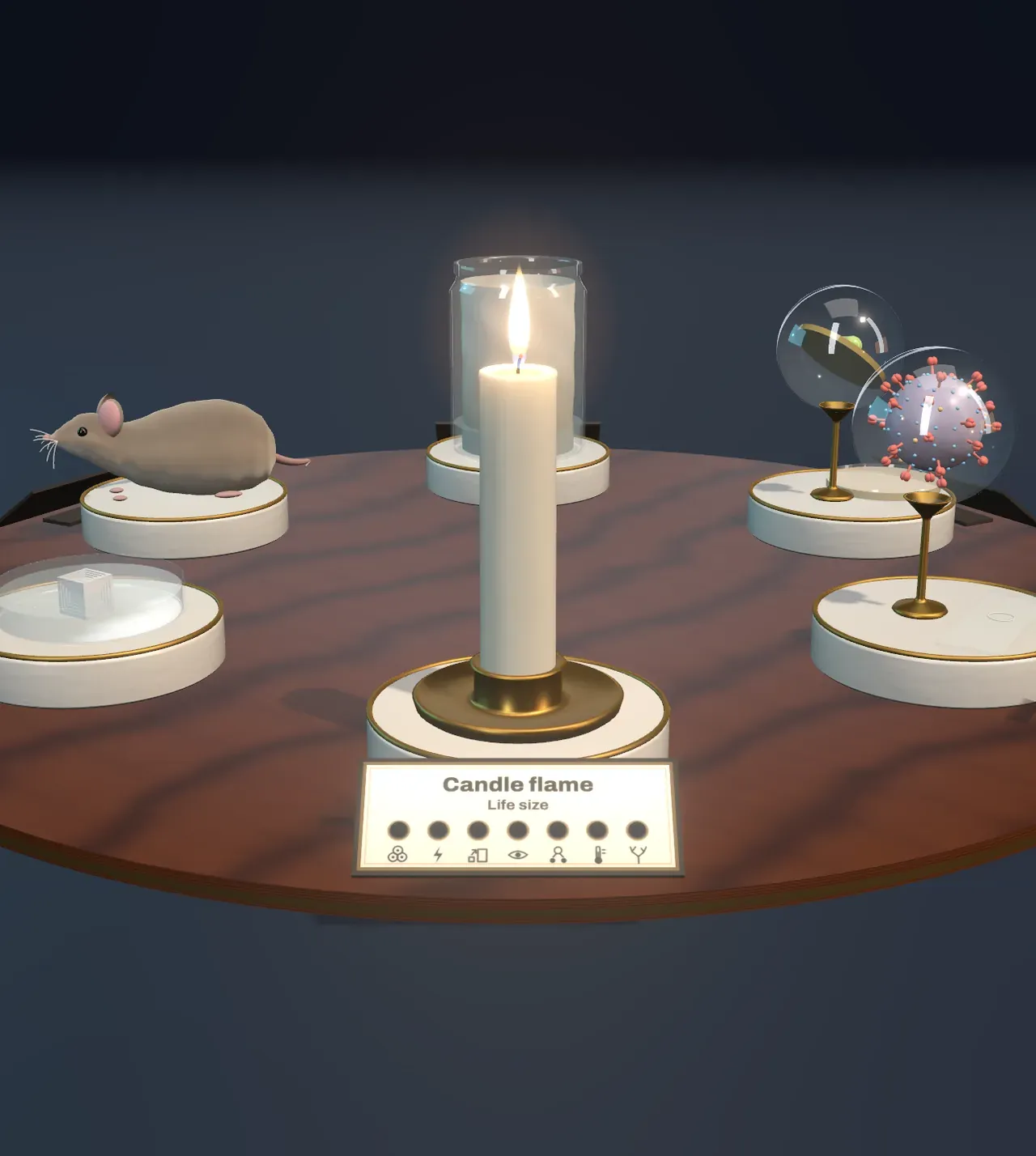
A flame that eats and breathes
Light a candle and watch it. The flame takes in fuel, the wax drawn up the wick, and oxygen from the air. It gives off carbon dioxide and water, and heat. It holds its shape for hours. Feed it more fuel and it grows; touch it to another wick and it makes a new flame. Starve it of air and it dies.
That is a fair list of what living things do. Yet nobody thinks a candle flame is alive. Something is missing, and finding out what it is turns out to be one of the best ways into the question of what life is.
There is no single test. Biologists recognise life by a set of signs that living things show together. The Scene checks six specimens against seven of them: a salt crystal, a candle flame, a virus, a bacterium, a bean seed and a mouse.
Seven signs of life
- Made of cells. Every living thing is built of one or more cells: a small bag of water and chemicals inside a membrane, able to run its own chemistry. A bacterium is one cell; a mouse is billions.
- Uses energy. Living things take in food or light and use it to run the reactions that build and repair them. All of this chemistry together is called metabolism. Most cells release the energy in food by combining it with oxygen, giving off carbon dioxide and water, which is cellular respiration.
- Grows. Living things grow from the inside, by making more of their own material, and many develop through a life cycle.
- Responds. They sense changes around them and react: a bacterium swims towards food, a root turns downwards, a mouse runs from a cat.
- Reproduces. They make offspring, and the offspring inherit instructions from their parents, written in DNA.
- Keeps steady inside. They hold their insides steady while the world outside changes: the right amount of water and salt in each cell, and in a mouse a body temperature near 37 °C. This balancing is called homeostasis; Homeostasis shows how a human body does it.
- Evolves. Over generations, inherited instructions change by mutation, and the versions that survive and reproduce best become common. That is evolution by natural selection.
Try it: step Test each sign through Cells, Energy and the rest. At every step all six placards light one lamp: blue for yes, amber for a look-alike or for something done only with a host’s help, red for no. The scorecard beside the Scene collects them.
The look-alikes: a crystal and a flame
A salt crystal hung in salty water grows. As the water evaporates, sodium and chloride ions come out of solution and stick to its faces, fastest at its edges and corners, which is why its faces sink into stepped hollows. Chips that break off start new crystals, each the same cube as its parent. Set Time watched to a week and the crystal has nearly doubled, with new crystals beside it.
But the crystal grows only from the outside, by things sticking to it, and it uses no energy to do so. Its “offspring” copy its shape because salt can only stack one way, not because it passes on any instructions. Nothing about one crystal can be inherited by the next, so crystals cannot evolve. At the Cells stop the crystal turns glassy to show what it is made of: not cells, just ions stacked in a grid.
The flame is a better impostor. At the Energy stop, oxygen flows into it and carbon dioxide and water flow out, the same exchange a mouse makes when it breathes. The chemistry is close too: burning wax and respiring sugar both combine carbon compounds with oxygen. The difference is control. A cell releases the energy in small steps through enzymes and stores it to use where it needs to; a flame lets it all go at once as heat and light. And when the candle runs out, the flame goes out: watch the candle burn down until, after seven and a half hours, nothing is left. Nothing inherited carries on.
The border: a virus
A virus is a few genes, in RNA or DNA, packed in a protein shell. At the Cells stop the globe cuts one open: inside is its genome and nothing else, no ribosomes to make proteins, no chemistry to make energy. Leave it for a week and nothing happens at all.
But put it beside the right cell and it takes the cell over. The cell’s own machinery copies the virus’s genes and builds hundreds of new viruses, which burst or bud out to find more cells. Those copies are not perfect, so viruses mutate, and the versions that spread best win out. Viruses evolve, often faster than anything else, as the Viruses Article and the new variants of every flu season show.
So a virus has one sign of life fully, evolution, and a second, reproduction, only with a host’s help. Whether that makes it alive depends on where you draw the line. Many biologists call viruses not alive but part of life: they cannot live on their own, but they belong to the same story of genes and evolution as everything that does.
Alive: a bacterium, a seed and a mouse
An E. coli bacterium is the simplest thing on the bench that ticks every box. It is one cell, with its own DNA, ribosomes and membrane. It takes in food and oxygen, grows to twice its length and splits in two, every 20 minutes at body temperature. Set Time watched to an hour and the globe holds eight cells; by a day there are hundreds of millions, a colony you can see by eye on the dish. The Bacteria Article follows one division in detail.
The bean is a stranger case. Dry, it looks no more alive than a pebble: its metabolism has slowed almost to nothing, and it can wait like that for years. A date palm seed about 2,000 years old, found in the ruins of Masada, was sprouted in 2005. Give the bean water and it swells within hours, its root breaks out after a day or so and turns to grow downwards, and by a week a shoot with its first leaves has climbed out of the jar. Life can pause; what a dead seed has lost, and a dormant one keeps, is the ability to start up again.
The mouse ticks every box without effort. It is made of billions of cells of hundreds of kinds; it breathes about two or three times a second; it holds its body near 37 °C; it hears, smells and runs; and its pups inherit a mix of both parents’ genes.
Why life is a package
Look down the scorecard and a pattern appears. The flame has much of the chemistry of life without heredity: it keeps busy, but nothing it does is passed on. The virus has heredity without the chemistry: it carries instructions that evolve, but cannot follow them by itself. Living things have both, joined inside a cell: instructions that build the machinery, and machinery that copies the instructions. NASA’s working definition puts it in one line: life is a self-sustaining chemical system capable of Darwinian evolution.
That joining also explains how life keeps its order. A cell is a highly organised thing in a universe that tends towards disorder, and it pays for its order by taking in energy and giving off heat and waste, as Entropy and heat engines explains. To see what a cell is made of, start with Cells; for the living things too small to see, try Microscopic life.
What this model leaves out
The seven signs are one common way to list the signs of life; textbooks differ (some add movement or excretion, some fold growth into development), and marking a sign as a “look-alike” is a judgement. The specimens are typical, not measured: a salt crystal in a dish of evaporating brine, a candle burning about a centimetre an hour, E. coli doubling every 20 minutes until the food under its colony runs low, and a broad bean at room temperature. The bacterium’s globe draws each cell only up to 256 of them, then shows the colony as a mound. The virus is shown floating free; on a real slide it would be dried and invisible even under a light microscope. The molecules at the Energy check are a picture of the exchange, not a count, and the mouse’s billions of cells are shown only as a pattern on its surface.